Fantasy Cricket Tips: The Ultimate 2026 Strategy Guide
Get the ultimate fantasy cricket tips for beginners! Learn our 2026 strategy for team selection, research, and bankroll management to start winning today.

Picking your favorite players is the fastest way to lose your ₹49 entry fee in 2026. Most Indian fans treat fantasy cricket like a loyalty test for their favorite stars, only to see their rankings plummet when a big name fails to deliver. If you're looking for fantasy cricket tips for beginners, the first thing to realize is that winning requires data-backed logic rather than emotional fandom. It's frustrating to watch your entry fee vanish because of poor team balance or a missed toss update, but it doesn't have to be that way.
We know that the transition from a casual viewer to a strategic player can feel overwhelming, especially with complex point systems across different formats. This guide promises to help you master the art of team selection and research, giving you the tools to transform into a consistent winner in both small and mega leagues. You'll learn a repeatable system for evaluating player stats and managing last-minute lineup changes effectively. Let's look at how you can build a squad that performs under pressure and secures more consistent results.
Key Takeaways
- Master the fundamental fantasy cricket tips for beginners by learning how to balance your XI within the standard 100-credit salary limit.
- Discover how to decode the 2026 points system to prioritize players who earn high bonuses for boundaries, wickets, and economy rates.
- Apply a five-step research framework that accounts for pitch behavior and weather changes to gain an edge over casual fans.
- Use the 'Core 7' strategy to build a stable team foundation while utilizing all-rounders to maximize your scoring potential.
- Learn to avoid costly mistakes like missing the toss update or over-investing in a single match through better bankroll management.
Understanding the Basics of Fantasy Cricket in 2026
Fantasy cricket is a virtual skill-based game where you step into the shoes of a professional team owner. Instead of just watching from the sidelines, you're responsible for scouting players and assembling a squad that competes against others. To grasp the basics of fantasy sports, you must realize that success isn't about luck; it's about your ability to analyze data and predict performance. In the Indian market, fantasy cricket is legally recognized as a "Game of Skill," which means your knowledge of the sport is your greatest asset. You are given a "Salary Cap," typically 100 credits, to buy 11 players for your team. Each player is assigned a credit value based on their recent form and reputation, forcing you to make tough choices to stay within budget.
Your core objective is to maximize your total points based on the real-world performance of your selected players during a live match.
The Shift from Fan to Fantasy Manager
One of the most valuable fantasy cricket tips for beginners is to leave your emotions at the door. As a fan, you might want your favorite player to score a century every game. As a manager, you have to look at the cold, hard facts. If your favorite batsman is struggling against left-arm pace and the opposition has a world-class left-arm seamer, picking him is a strategic mistake. Analyzing for points is different from watching for fun. You need to remain objective, even when your home team is playing. If a particular pitch is looking like a "bowler's graveyard," you should prioritize power-hitters over defensive anchors, regardless of who you usually cheer for.
Essential Terminology for Beginners
Before you join your first contest, you need to speak the language of the game. Here are the terms you'll encounter daily:
- Credits: The virtual currency used to "buy" players. High-performing stars cost more, often 9.5 or 10 credits.
- Playing XI: The final list of eleven players who will actually take the field. This is only confirmed after the toss.
- Toss Update: The most critical window for a manager. You have roughly 30 minutes after the toss to finalize your team.
- Announced vs. Unannounced: Apps will highlight players as "Announced" once the official team sheets are out. Never pick an "Unannounced" player.
- Impact Players: In 2026 T20 formats, the "Impact Player" rule allows teams to swap a player mid-match. You need to account for these specialists as they can provide "bonus" points that others miss.
Understanding these fundamentals ensures you don't lose points before the first ball is even bowled. By treating your team like a business rather than a fan club, you're already ahead of the majority of casual players.
Decoding the Fantasy Cricket Points System
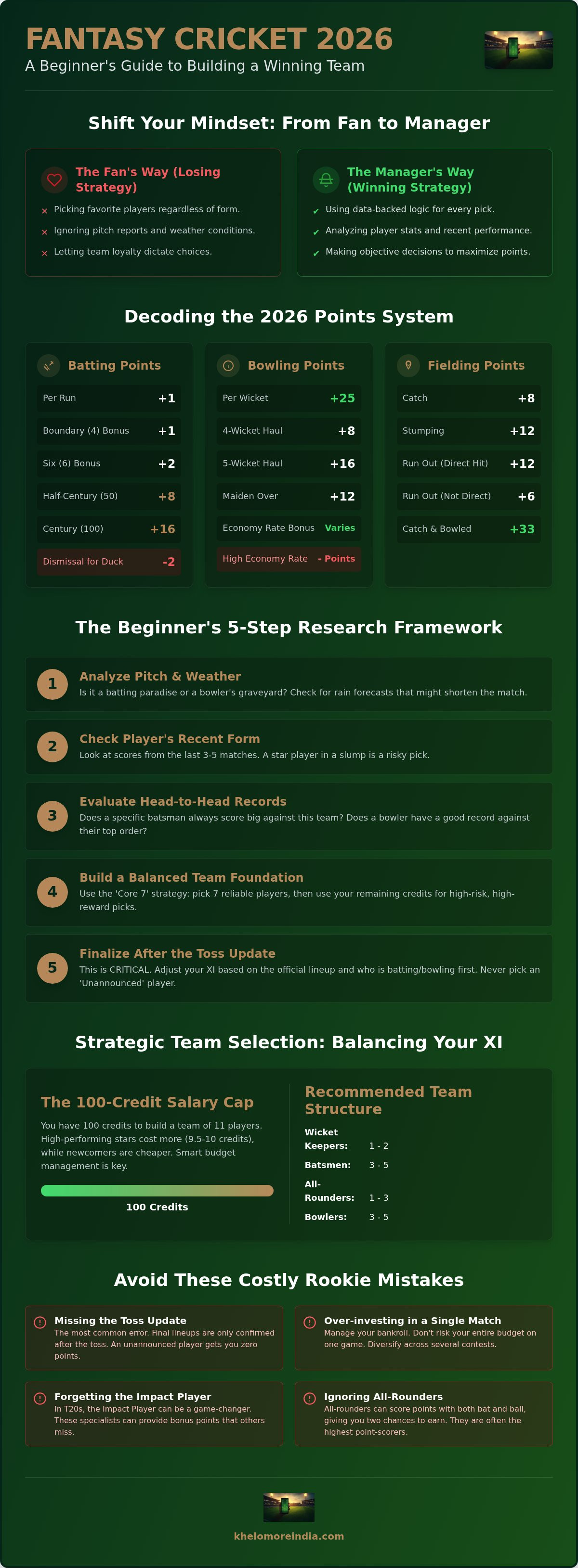
Points are the lifeblood of your team. You can't build a winning squad without knowing exactly how every run, wicket, and catch translates into your final score. While most casual fans focus on the scoreboard, a manager needs to focus on the point sheet. In 2026, the scoring systems have become more nuanced to reward high-impact play. One of the best fantasy cricket tips for beginners is to memorize the point weightage for the specific app you're using, as even a small difference in bowling bonuses can change your entire selection strategy.
Batting points generally start with 1 point for every run scored. However, you'll earn "bonus" points for boundaries (+1) and sixes (+2). Reaching milestones is where the big jumps happen; a half-century might net you an extra 8 points, while a century could grant a massive 16-point boost. Bowling is often the most reliable way to climb the rankings. A single wicket is typically worth 25 points, which is the equivalent of a batsman scoring 25 runs without any boundaries. You can also gain points for maiden overs (+8 to +12) and hat-trick bonuses, making disciplined bowlers incredibly valuable.
Don't overlook the "hidden" points found in fielding. A simple catch earns you 8 points, while stumpings and direct-hit run-outs usually provide 12 points each. These small additions often decide the winner in tight contests. On the flip side, you have to manage negative points. A "duck" will cost you -2 points. If a bowler's economy rate is too high or a batsman's strike rate is too low, you'll see your total score start to bleed. Balancing high-risk players with steady performers is key to maintaining a positive score.
Format-Specific Point Variations
The game changes depending on the length of the match. In T20s, the system heavily rewards explosive strike rates and death-over bowling where wickets fall frequently. Conversely, Test cricket fantasy focuses on longevity, rewarding players for every wicket taken and for staying at the crease for long periods. You can find a detailed breakdown of these differences in our fantasy cricket points system explained guide, which includes a full comparison table for 2026.
The Multiplier Effect: Captain and Vice-Captain
Your Captain (C) and Vice-Captain (VC) are the most critical decisions you'll make. Your Captain earns 2x points, and your Vice-Captain earns 1.5x points for the same performance. If your Captain scores a century, you're effectively getting the points for two centuries. If they get out for a duck, that negative score is also doubled. Choosing an all-rounder for these spots is often the safest bet because they can earn points with both bat and ball. For more advanced selection methods, check out our fantasy cricket captain and vice captain tips. To better understand these player roles, you might also want to explore KheloMore India's sports guides for insights into physical cricket training.
The Beginner's 5-Step Research Framework
Most new players make the mistake of picking a team based solely on name recognition. Success in fantasy sports isn't about how many stars you can fit into your squad; it's about how those players interact with the environment. If you want to win, you need a repeatable process. Here are the essential fantasy cricket tips for beginners to help you build a data-driven squad every single time.
- Step 1: Analyze the Pitch Report. Is the ground a "batting paradise" like the Wankhede or a "bowler's graveyard" for spinners? A dry, cracked surface favors spin, while a green top helps the pacers.
- Step 2: Check Weather Conditions. Heavy cloud cover often assists swing bowlers in the first few overs. Conversely, if there's dew expected in the second innings, the ball becomes slippery, making it harder for bowlers and easier for the chasing side to score.
- Step 3: Study Player Form. Look at the last 5 matches. A player's historical reputation doesn't earn points; their current rhythm does. If a big name has three consecutive low scores, they might be struggling with a technical flaw.
- Step 4: Evaluate Head-to-Head Stats. Some world-class batsmen have a "bunny" status against specific bowlers. If a top opener consistently struggles against left-arm pace, and the opposition has a specialist in that role, you might want to look elsewhere.
- Step 5: Monitor the Toss. This is the single most important real-time update. It confirms the playing XI and tells you which team will face the pressure of setting a total versus the advantage of chasing under lights.
Where to Find Reliable Data
Stick to reputable sports news sites and official league apps for your statistics. You can also use our best fantasy cricket picks today to save time on deep analysis. Don't fall for "WhatsApp leaks" or unverified social media tips. Most of these are guesswork and can lead to poor results. Reliable data is your best defense against the "set and forget" trap that catches many casual fans.
Understanding Player Roles and Matchups
Knowing a player's specific role is vital for maximizing points. Identify "Death Over" specialists who bowl the 18th and 20th overs. They often pick up "cheap" wickets as batsmen are forced to swing at every delivery. Similarly, prioritize "Top Order" batsmen who face the most deliveries in a match. A tactical matchup to watch is the "Left-arm pace vs. Right-hand bat" theory. Many right-handers struggle with the ball angled into them, making left-arm seamers high-value picks in modern T20 formats. Understanding these nuances helps you appreciate the sport more, and you can even check out KheloMore's guides on physical cricket coaching to better understand these technical player roles.
Strategic Team Selection: Balancing Your XI
Balancing your team is where many players fail. You only have 100 credits, and superstars often cost 10 credits each. If you pick five of them, you're left with only 50 credits for the remaining six players. This is where strategic fantasy cricket tips for beginners become vital. You need to identify your "Core 7"-these are the non-negotiable players who are likely to perform regardless of the match situation. These are usually your openers, strike bowlers, and top-tier all-rounders. The remaining four spots should be filled with "Budget Picks," players who cost around 8.0 to 8.5 credits but have the potential to punch above their weight.
When deciding how to split your team between the two competing sides, consider the match favorite. A 7-4 split in favor of the stronger team is a common tactic if one side is clearly dominant. However, if the match is between two evenly matched sides, a 6-5 split offers better stability. This ensures you aren't overly reliant on one team's performance, which is especially important if the pitch behaves unexpectedly. Always remember that your 11 players must work as a unit to cover as many scoring opportunities as possible.
The Power of All-rounders
All-rounders are the true "Gold Mine" of any fantasy squad. They provide a safety net; if they fail with the bat, they can still earn points with the ball. You should prioritize all-rounders who bat in the top 5 and bowl their full 4-over quota in T20s. Look for archetypes like the "hard-hitting finisher" who also bowls at the death, or the "spinning anchor" who controls the middle overs. These players stay involved in the game longer than specialists, making them the most reliable candidates for Captaincy because their point-scoring floor is much higher.
Risk Management: Small Leagues vs. Grand Leagues
Your selection strategy must change based on the contest size. In Small Leagues (2-10 members), you should play it safe. Stick to "popular" picks that most of your opponents will also have. This protects your entry fee because you won't fall behind the pack if a star performs. In Grand Leagues (thousands of members), you need "Differential Picks." These are players with low ownership-perhaps less than 15%-who can catapult you to the top of the leaderboard if they have a massive game. For a deeper dive into these nuances, read our guide on fantasy cricket team selection strategy. To understand the physical demands of these player roles better, you can explore KheloMore's sports booking guides for insights into professional coaching.
Avoiding Common Rookie Mistakes and Responsible Play
Many beginners lose their entry fees not because they lack cricket knowledge, but because they lack discipline. Even the most detailed research can't save a team that ignores basic execution. One of the most frequent errors is the "Set and Forget" trap. Fans often build their teams hours before the match and fail to check the final playing XI after the toss. If two of your star players are rested or injured, you've essentially started the game with only nine players. This is one of those fantasy cricket tips for beginners that separates the winners from the casual participants; always be present during the 30-minute window between the toss and the first ball.
Responsible play also involves strict bankroll management. It's tempting to put all your funds into a single high-stakes match, but this is a high-risk strategy that rarely pays off. If you have a weekly budget of ₹1,000, don't enter a single ₹1,000 contest. Instead, spread that amount across multiple matches and smaller leagues to reduce your risk. Never fall into the trap of chasing losses. If you've had a bad run, trying to "win it back" by entering more expensive contests usually leads to emotional, poor decision-making. Treat your fantasy budget like a fixed expense rather than a source of stress.
The "Toss Factor" is another nuance that rookies often ignore. The value of a player changes significantly depending on whether they are bowling first or second. For instance, death-over bowlers are often more valuable when bowling first, as they are guaranteed to bowl at the end of the innings when wickets fall most frequently. Conversely, if a team is bowling second on a ground known for heavy dew, their spinners might struggle to grip the ball, making them less effective picks.
A Daily Routine for Fantasy Success
To stay consistent, you need a pre-match ritual. Spend the last 30 minutes before the deadline checking official news, the toss result, and the final team sheets. Once the match ends, don't just look at your rank. Review your performance by analyzing why your picks succeeded or failed. Did a player fail because of a good ball, or did you ignore a tactical matchup? Staying updated with 2026 player fitness reports and any sudden rule changes in the league is also essential for long-term growth.
Conclusion: Developing Your Winning Instinct
Fantasy cricket is a marathon, not a sprint. Success comes from the cumulative effect of small, data-driven decisions rather than one-off "lucky" picks. By mastering the points system, building a solid research framework, and managing your team with discipline, you'll find yourself climbing the leaderboards more consistently. We hope these strategies help you enjoy the sport on a much deeper level. For more ways to improve your understanding of the game, explore more cricket guides and coaching insights on KheloMore India.
Master the Match Before the First Ball
Success on the fantasy leaderboard is built on the foundation of objective research and disciplined execution. You now have a framework to analyze pitches, weather, and player matchups without letting team loyalty cloud your judgment. Remember that managing your virtual credit budget is just as important as picking the right Captain. By avoiding common traps like the "set and forget" mistake and managing your bankroll responsibly, you're already ahead of the casual competition. It's about making informed choices that turn the uncertainty of cricket into a calculated advantage.
These fantasy cricket tips for beginners provide a clear path to becoming a more consistent winner in 2026. Whether you're playing in small leagues or aiming for a mega contest, staying informed is your greatest advantage. For expert-led sports guides and comprehensive 2026 cricket insights, start your sports journey with KheloMore India. As a resource trusted by Indian sports families, we're here to help you understand the technical and strategic side of the game. Keep refining your strategy, trust your data, and enjoy every moment of the season.
Frequently Asked Questions
Is fantasy cricket legal in India?
Yes, fantasy cricket is legal in most Indian states because it's classified as a "Game of Skill" rather than gambling. The Supreme Court of India has upheld this status, recognizing that success depends on a player's knowledge and analytical ability. However, certain states like Andhra Pradesh, Telangana, and Assam have specific restrictions, so you should always check your local regulations before joining paid contests.
How do I choose the best Captain and Vice-Captain for my team?
You should prioritize players who have multiple ways to earn points, particularly all-rounders who bat in the top five and bowl their full quota of overs. Since your Captain earns 2x points and your Vice-Captain earns 1.5x, selecting a consistent performer is much safer than picking a high-risk player. Look at recent form and venue history to ensure your multipliers are placed on reliable stars.
What happens if a player I selected is not in the starting XI?
If a selected player doesn't play, they'll earn zero points for your team. To avoid this, you must check the official "Playing XI" announced after the toss, which usually happens 30 minutes before the match starts. Most modern apps now offer a "Substitute" or "Backup" feature that can automatically replace non-playing cricketers in your squad if you forget to make manual changes.
Can I play fantasy cricket for free as a beginner?
Yes, almost every major platform offers "Practice Contests" or "Free Leagues" where you can compete without paying an entry fee. These are excellent fantasy cricket tips for beginners because they allow you to test your research strategies and understand the points system without any financial risk. Once you feel confident in your selection process, you can move to small-fee contests starting as low as ₹1.
What is the most important factor to consider before making a team?
The pitch report is the most critical factor because it dictates how the entire match will unfold. A dry pitch that offers turn makes spinners high-value picks, while a green surface with grass cover favors fast bowlers who can swing the ball. Always align your team selection with the expected behavior of the surface to ensure your players are in the best position to earn points.
How much money should I start with in fantasy cricket?
You can start with as little as ₹50 to ₹100 to enter a few small contests and get a feel for the game. The key is to practice responsible bankroll management by never investing more than 10% of your total wallet balance in a single match. Starting with small amounts helps you learn the nuances of player selection and point calculations without the pressure of significant losses.
What is a 'Differential Pick' and why is it important?
A 'Differential Pick' is a player with low ownership, typically selected by less than 20% of managers in a contest. These picks are vital in Grand Leagues because they allow you to jump ahead of thousands of competitors if that specific player performs well. While your "Core 7" provides stability, 2-3 well-researched differential picks are often what help you win the biggest prizes.
How do pitch conditions affect my player selection?
Pitch conditions determine the balance of your XI; for example, on a "batting beauty" like the Chinnaswamy Stadium, you should pick extra top-order batsmen. If the surface is slow and sluggish, you'll need more finger spinners and bowlers who use variations like slower balls. These fantasy cricket tips for beginners help you adapt your squad to the specific ground reality of each match rather than relying on names alone.
Common questions
Is fantasy cricket legal in India?
Yes, fantasy cricket is legal in most Indian states because it's classified as a "Game of Skill" rather than gambling. The Supreme Court of India has upheld this status, recognizing that success depends on a player's knowledge and analytical ability. However, certain states like Andhra Pradesh, Telangana, and Assam have specific restrictions, so you should always check your local regulations before joining paid contests.
How do I choose the best Captain and Vice-Captain for my team?
You should prioritize players who have multiple ways to earn points, particularly all-rounders who bat in the top five and bowl their full quota of overs. Since your Captain earns 2x points and your Vice-Captain earns 1.5x, selecting a consistent performer is much safer than picking a high-risk player. Look at recent form and venue history to ensure your multipliers are placed on reliable stars.
What happens if a player I selected is not in the starting XI?
If a selected player doesn't play, they'll earn zero points for your team. To avoid this, you must check the official "Playing XI" announced after the toss, which usually happens 30 minutes before the match starts. Most modern apps now offer a "Substitute" or "Backup" feature that can automatically replace non-playing cricketers in your squad if you forget to make manual changes.
Can I play fantasy cricket for free as a beginner?
Yes, almost every major platform offers "Practice Contests" or "Free Leagues" where you can compete without paying an entry fee. These are excellent fantasy cricket tips for beginners because they allow you to test your research strategies and understand the points system without any financial risk. Once you feel confident in your selection process, you can move to small-fee contests starting as low as ₹1.
What is the most important factor to consider before making a team?
The pitch report is the most critical factor because it dictates how the entire match will unfold. A dry pitch that offers turn makes spinners high-value picks, while a green surface with grass cover favors fast bowlers who can swing the ball. Always align your team selection with the expected behavior of the surface to ensure your players are in the best position to earn points.
How much money should I start with in fantasy cricket?
You can start with as little as ₹50 to ₹100 to enter a few small contests and get a feel for the game. The key is to practice responsible bankroll management by never investing more than 10% of your total wallet balance in a single match. Starting with small amounts helps you learn the nuances of player selection and point calculations without the pressure of significant losses.
What is a 'Differential Pick' and why is it important?
A 'Differential Pick' is a player with low ownership, typically selected by less than 20% of managers in a contest. These picks are vital in Grand Leagues because they allow you to jump ahead of thousands of competitors if that specific player performs well. While your "Core 7" provides stability, 2-3 well-researched differential picks are often what help you win the biggest prizes.
How do pitch conditions affect my player selection?
Pitch conditions determine the balance of your XI; for example, on a "batting beauty" like the Chinnaswamy Stadium, you should pick extra top-order batsmen. If the surface is slow and sluggish, you'll need more finger spinners and bowlers who use variations like slower balls. These fantasy cricket tips for beginners help you adapt your squad to the specific ground reality of each match rather than relying on names alone.