Fantasy Cricket Team Selection Strategy: The Ultimate 2026 How-To Guide
Stop losing! Master our 2026 fantasy cricket team selection strategy. Learn to analyze pitches, pick captains & build a winning lineup with our expert guide.

Why does your ₹49 entry fee keep disappearing even when you pick the highest-rated superstars? It's incredibly frustrating to watch "big names" fail while a budget pick you ignored scores a century. You're likely tired of losing credits on players who don't perform or realizing too late that the pitch was a spinner's paradise. We understand that building a winning lineup feels like a gamble when it should be a science.
Our goal is to turn that frustration into a winning streak. We'll help you master a data-driven fantasy cricket team selection strategy specifically designed for the 2026 season. You'll learn how to stop chasing reputations and start maximizing your points per credit. This guide provides a repeatable system for analyzing pitch conditions, selecting the right captain, and understanding which player stats actually matter for your success in both grand leagues and small contests.
Key Takeaways
- Learn to prioritize points over player reputations by analyzing how the 2026 scoring systems reward specific actions like strike rates and maiden overs.
- Discover how to implement a winning fantasy cricket team selection strategy by balancing your 11-player squad using tactical 7-4 or 6-5 splits.
- Master pre-match research by evaluating pitch reports and weather forecasts to determine if you should load up on spinners or top-order batsmen.
- Identify "differential picks" with low ownership to climb grand league leaderboards and use captaincy multipliers to maximize your scoring potential.
- Use our final 30-minute checklist to adjust your lineup based on the toss and official playing XI announcements to avoid "Did Not Play" zeroes.
The Foundation: Aligning Strategy with the Fantasy Cricket Points System
Winning at fantasy sports starts with a total mindset shift. You aren't just picking a cricket team; you are building a point-generating machine. Many fans fail because they select players based on emotional loyalty or past glory. A successful fantasy cricket team selection strategy requires looking past the names on the jersey and focusing entirely on the data. It is about understanding that a gritty 30 runs from a lower-order batsman might be worth less than two wickets from a budget bowler who bowls during the death overs.
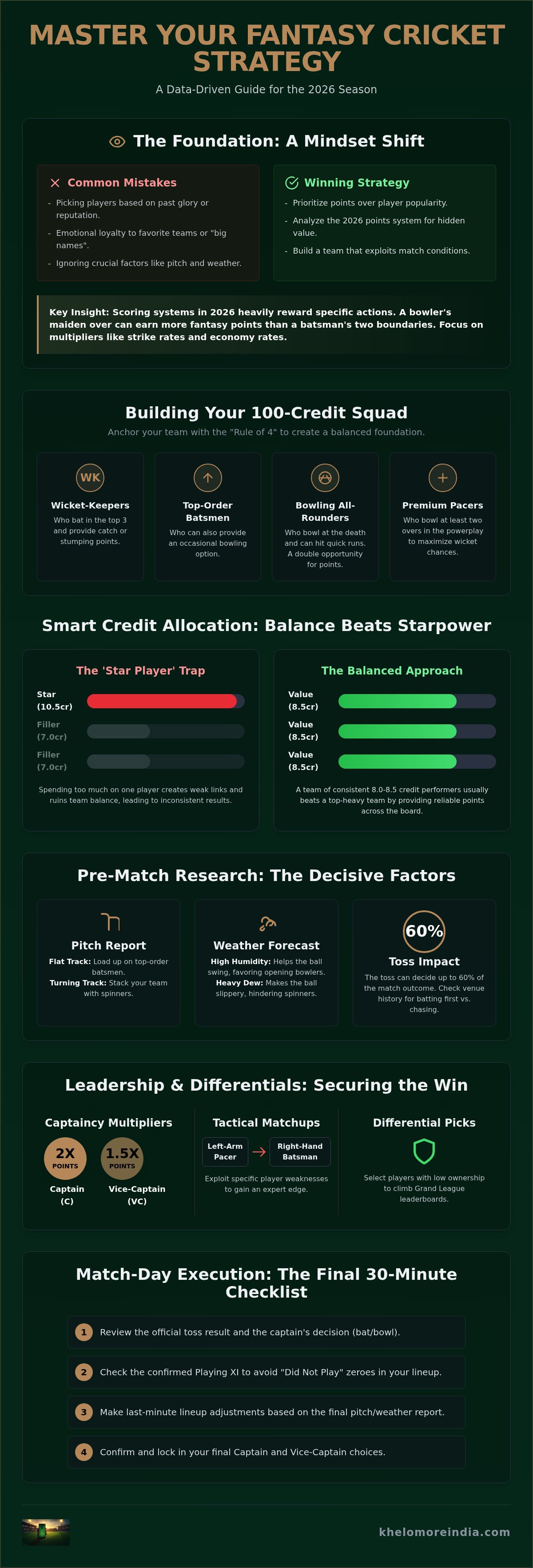
In 2026, the game is more nuanced than ever. You must analyze the fantasy cricket points system explained to see how weightage has shifted toward specialized roles. For instance, a bowler who bowls a maiden over in a T20 match often earns more points than a batsman hitting a couple of boundaries. High strike rates and economy rates now carry significant bonuses. If you don't account for these multipliers, you'll struggle against experienced players who exploit these small margins to climb the leaderboards.
Most platforms give you a strict 100-credit limit to build your 11-player squad. To stay within this budget, use the 'Rule of 4'. This involves identifying four core players who are guaranteed to contribute in multiple departments. These players are your anchors. Once they are locked in, you can distribute the remaining credits more flexibly across the rest of the squad. Your core should typically include:
- Wicket-keepers who bat in the top 3 and provide catch or stumping points.
- Bowling All-rounders who bowl at the death and can hit quick runs.
- Top-order Batsmen who also provide an occasional bowling option.
- Premium Pacers who bowl at least two overs in the powerplay.
Budget Management: Avoiding the 'Star Player' Trap
It's tempting to load your team with every "big name" available. However, spending 10.5 credits on a fading superstar often leaves you with 7.0-credit "fillers" who rarely score. This ruins your team balance. Instead, look for 'Value Picks' priced between 8.0 and 8.5 credits. These are often young, hungry players or consistent domestic performers with high ceiling potential. Spread your credits so you don't have a massive weak link in your bowling or batting order. A balanced team of 8.5-credit performers usually beats a top-heavy team every time.
The Power of All-Rounders in 2026
All-rounders are the gold mine of any fantasy cricket team selection strategy. They offer a 'Double Opportunity' to score points. In the 2026 season, prioritize players who bat in the top 5 and are likely to bowl their full quota of overs. In T20s, a bowling all-rounder who bats at number 7 might be less valuable than a batting all-rounder who opens the innings. Always compare the format. In longer matches, bowling all-rounders usually provide a safer floor for your total points because they are guaranteed to bowl more deliveries and stay involved in the game longer.
Pre-Match Research: Pitch Reports, Weather, and Matchups
Before you finalize your 11, you must look at the ground. A 'belter' of a pitch, favoring batsmen, requires a completely different fantasy cricket team selection strategy than a 'dust-bowl' that assists bowlers. On a flat track, you want as many top-order batsmen as possible. On a turning track, three quality spinners become non-negotiable. Weather is equally critical. High humidity helps the ball swing early on, making opening bowlers deadly. Conversely, heavy dew in the second innings makes the ball slippery, often rendering even the best spinners ineffective. Always check the ground history to see if the venue favors the team batting first or the side chasing under lights.
To simplify this process, you can use our best fantasy cricket picks today to filter out players who don't fit the current venue's profile. Ground history often dictates whether you should stack your team with power-hitters or disciplined medium pacers. In many venues, the toss can decide up to 60% of the match outcome, so your research must account for how a captain's decision at the toss will change the playing conditions.
Tactical Matchups: The Secret to Selection
Tactical matchups are where the experts pull ahead of the crowd. Don't just pick a great batsman; check who is bowling against them. Left-arm pacers often trouble right-handed openers by bringing the ball back in. If a team has two world-class left-armers and the opposition has a right-handed top three, you might want to bench one of those star batsmen. Similarly, identify bowlers who specialize in the 'Death Overs'. These players often concede runs but pick up two or three wickets in the final few balls, providing a massive boost to your total points.
Interpreting Recent Form vs. Career Stats
Recent momentum is almost always more important than a player's career average. We recommend the 'Last 5 Matches' rule. If a player has failed four times in their last five outings, their confidence is likely low, regardless of their 'Class'. However, keep an eye out for players who are hitting the ball well but getting out to lucky catches or great deliveries. These players are 'due' for a big score. Balancing this intuition with hard data is what separates a knowledgeable guide from a casual fan. If you're feeling overwhelmed by the data, our sports booking guides can help you understand the real-world coaching nuances that influence these performances.
The Selection Framework: Building the 11-Player Squad
Once your pre-match research is complete, you need a structural blueprint for your team. A common mistake is picking players at random until the credits run out. A winning fantasy cricket team selection strategy relies on choosing the right team split. If one team is a heavy favorite, use a 7-4 split by picking seven players from the stronger side. In a more competitive game, a 6-5 split is safer. This balance ensures you don't over-invest in one side when the match could swing either way.
Your batting priority should almost always be the top three batsmen from both sides. These players face the maximum number of deliveries and have the best chance to score big. When choosing your wicket-keeper, look beyond just catching skills. Pick the keeper who bats higher in the order. This gives them a double chance to earn points through both runs and "stumping" bonuses. For T20 matches, many experts use a 2-3-3-3 template as a starting point; two wicket-keepers, three batsmen, three all-rounders, and three bowlers. This provides a versatile base that you can tweak based on the pitch conditions we discussed earlier.
Selecting Your Bowling Attack
In fantasy cricket, "Strike Bowlers" are far more valuable than "Economical Bowlers". A bowler who gives away 40 runs but takes three wickets will always outscore a bowler who gives away only 15 runs but takes no wickets. Wickets are the primary currency of the bowling department. Always prioritize "Death Over" specialists. These bowlers operate in the final four overs of an innings when batsmen are forced to take risks. It is the easiest way to hunt for three-wicket hauls. If the pitch report suggests it is a "dust-bowl", load up on spinners who bowl in the middle overs to capitalize on the dry surface.
The Anchor vs. The Aggressor
A balanced batting lineup needs a mix of stability and explosive power. Every team needs at least one "Anchor" batsman. These are steady players who might not hit many sixes but stay at the crease for a long time. They ensure your team doesn't get "zeroed" out if a collapse occurs. On the other hand, you need "Aggressors" for the Powerplay. These players aim to capitalize on early boundary bonuses while only two fielders are outside the circle. Balancing high-risk openers with steady middle-order accumulators creates a safety net for your total score, protecting you from the unpredictability of the 2026 season matches.
Leadership and Differentials: Securing the Win
Selecting a strong 11-player squad gets you into the contest, but your multipliers determine if you actually win it. In most Indian fantasy platforms, your captain earns 2x points and your vice-captain earns 1.5x. This means two players alone can account for nearly 25% of your total score. A successful fantasy cricket team selection strategy involves more than just picking the best player as your leader. You must master the specific fantasy cricket captain and vice captain tips that align with match conditions. Often, your vice-captain should be a 'Safe' pick; a consistent performer who provides a points floor. Your captain can then be a 'Bold' pick with the potential to break the slate.
Your leadership choices should also be toss-dependent. If a team is bowling first on a green pitch, a world-class swing bowler becomes a prime captaincy candidate. If they are batting first on a flat track, an aggressive opener is the better bet. Don't be afraid to change your leader at the last minute based on who is batting or bowling first. If you need more help refining these tactical calls, our fantasy cricket strategy guides offer deeper insights into match-day decision making.
Identifying Differential (Trump) Players
Differential picks are players with less than 20% ownership who can catapult you to the top of the rankings. While everyone else is fighting over the same three superstars, you can gain a mathematical edge by finding the 'Trump' players the crowd is ignoring. Look for uncapped domestic talent or high-quality players returning from injury. These players are often underpriced and under-owned. Another effective tactic is the 'Third Seamer' strategy. While the crowd picks the two famous opening bowlers, the third seamer often reaps the rewards of the pressure built at the other end, picking up cheap wickets against lower-order batsmen.
Captaincy Logic for Different Formats
The format of the game dictates your leadership risk profile. In T20s, all-rounders or openers are the gold standard for captaincy because they have the most opportunities to involve themselves in the game. In ODIs, the logic shifts toward top-order batsmen who have the temperament to play a long, 100-run innings. For small leagues with only a few participants, stick to a 'Safe Captain' like a reliable all-rounder to protect your entry fee. For Grand Leagues with thousands of entries, you need a 'Wildcard Captain'; someone with low ownership who has a massive ceiling. This high-risk approach is the only way to beat the thousands of other teams using the same fantasy cricket team selection strategy as the general public.
Match-Day Execution: The Final 30-Minute Checklist
The thirty minutes between the toss and the first ball are the most critical moments for any player. This is when your fantasy cricket team selection strategy moves from theory to reality. You must wait for the official 'Playing XI' announcement before making your final moves. Nothing ruins a well-researched team faster than a 'Did Not Play' (DNP) zero because a star player was rested or picked up a last-minute niggle. Once the sheets are out, quickly scan for any surprises in the batting order or unexpected debutants who might offer massive value at a low credit cost.
If a high-credit superstar is missing from the lineup, don't just pick a random replacement. Use those extra credits to upgrade your weakest link. This is your chance to swap a 7.5-credit filler for a high-ceiling 8.5-credit player you couldn't afford earlier. Check the pitch one last time via the live broadcast. If the grass has been shaved off since the morning preview, it might be time for a 'Last Minute Switch' of your captain from a pacer to a top-order batsman who can feast on a flat deck.
The Toss Reaction Framework
The toss should dictate your final squad balance. If a team chooses to bowl first on a green, humid track, you should load up on their opening pacers and death-over specialists. In this scenario, the chasing team's top-order batsmen are often safer picks because they'll know exactly what target they need to hit. Conversely, if a team bats first on a dry surface, focus on 'Anchors' who can set a competitive target. Spinners generally become much more dangerous in the second innings as the pitch wears down and the ball begins to grip. Also, keep an eye on 'Impact Players' under the 2026 rules. A specialist bowler who only enters the game as a substitute can be a goldmine if they bowl their full quota of overs at a bargain price.
Final Team Validation
Before the deadline hits, perform a quick audit of your squad. Ensure you have at least one player representing every key phase of the game, from the opening powerplay to the final death overs. A common mistake is forgetting to hit 'Save' after making a frantic last-second change. Verify that your Captain and Vice-Captain selections are confirmed and that your multipliers are active. It's also wise to check the Best Fantasy Cricket Picks Today one last time to ensure no late-breaking news or weather updates have shifted the tactical landscape. Once your team is locked, trust your research and the data-driven framework you've built.
Take Control of Your 2026 Fantasy Season
Winning consistently isn't about luck; it's about applying a disciplined fantasy cricket team selection strategy. By moving beyond player reputations and focusing on points-per-credit, pitch-specific matchups, and high-impact differentials, you've already gained a massive advantage over the casual competition. You now have a repeatable framework to handle everything from credit management to those high-pressure minutes after the toss. The final 30 minutes are where the best managers secure their wins by reacting to the playing XI and ground conditions.
At KheloMore India, we're dedicated to helping you navigate the complex world of Indian sports with clarity. Our expertly researched 2026 cricket insights and practical tips from seasoned sports analysts provide the edge you need to succeed. We offer comprehensive guides for Indian sports families to help simplify every decision, whether you're on the field or managing a virtual team. Master your sports knowledge with the KheloMore India booking guide and start making more informed decisions today. You've got the tools and the data; now it's time to climb those leaderboards with confidence!
Frequently Asked Questions
What is the most important factor in fantasy cricket team selection?
The pitch and ground conditions are the most critical factors. These determine whether the match will be a high-scoring "belter" or a low-scoring struggle for batsmen. For instance, a dry surface in Chennai demands more spinners, while a green track in Dharamshala requires swing bowlers. Understanding the environment allows you to predict which players will face the most deliveries or bowl the most effective overs.
Should I always pick the best-performing players in my fantasy team?
No, you shouldn't just chase big names or high averages. Fantasy cricket is about maximizing points within a 100-credit limit. Sometimes a fading superstar priced at 10.5 credits provides less value than a young, in-form player at 8.0 credits. You need to balance your budget to ensure you don't have weak links who earn zero points, as a balanced squad usually beats a top-heavy one.
How many all-rounders should I ideally have in my squad?
You should ideally aim for 3 to 4 all-rounders in T20 matches. These players are the safest assets because they offer a "double opportunity" to score. Even if they fail with the bat, they can earn points through wickets or catches. In the 2026 season, prioritize those who bat in the top five and are guaranteed to bowl at least three overs for maximum impact.
Is it better to pick more batsmen or more bowlers?
Bowlers are often more consistent point earners than batsmen. While a batsman can get out on the first ball, a specialist bowler usually gets multiple chances to take a wicket. In the current points system, a single wicket is often worth 25 points, which is roughly equivalent to a batsman scoring 30 to 40 runs. Prioritizing death bowlers is a proven way to secure high scores.
How do I choose between two players with the same credit value?
Use tactical matchups and recent form as your tie-breakers. If two players both cost 8.5 credits, check who is facing a bowling type they historically struggle against. For example, if one batsman is weak against leg-spin and the opposition has two quality leg-spinners, pick the other player. Always favor the player who bats higher in the order or bowls during the final overs of the innings.
What is a 'Differential Pick' and why is it important?
A differential pick is a player with an ownership percentage below 20%. These players are essential for winning Grand Leagues because they help you stand out from the "template" teams everyone else is using. If your differential pick performs well, you will climb thousands of ranks instantly. It's a high-risk, high-reward tactic that separates professional managers from casual fans who only pick popular players.
How does the toss affect my final team selection strategy?
The toss is the final piece of the puzzle that confirms the match conditions. If a team bowls first on a fresh pitch, your fantasy cricket team selection strategy should shift toward picking their opening pacers. If a team bats first on a slow track, you should focus on their spinners for the second innings. The toss also reveals the official playing XI, helping you avoid "Did Not Play" zeroes.
Can I win fantasy cricket without doing deep statistical research?
You might win occasionally through luck, but long-term success requires a data-driven fantasy cricket team selection strategy. Researching strike rates, economy rates, and venue history minimizes the element of chance. While basic knowledge helps in small contests with friends, competing in larger leagues requires analyzing how specific players perform under different weather and pitch conditions to ensure consistent returns on your entry fees.
Common questions
What is the most important factor in fantasy cricket team selection?
The pitch and ground conditions are the most critical factors. These determine whether the match will be a high-scoring "belter" or a low-scoring struggle for batsmen. For instance, a dry surface in Chennai demands more spinners, while a green track in Dharamshala requires swing bowlers. Understanding the environment allows you to predict which players will face the most deliveries or bowl the most effective overs.
Should I always pick the best-performing players in my fantasy team?
No, you shouldn't just chase big names or high averages. Fantasy cricket is about maximizing points within a 100-credit limit. Sometimes a fading superstar priced at 10.5 credits provides less value than a young, in-form player at 8.0 credits. You need to balance your budget to ensure you don't have weak links who earn zero points, as a balanced squad usually beats a top-heavy one.
How many all-rounders should I ideally have in my squad?
You should ideally aim for 3 to 4 all-rounders in T20 matches. These players are the safest assets because they offer a "double opportunity" to score. Even if they fail with the bat, they can earn points through wickets or catches. In the 2026 season, prioritize those who bat in the top five and are guaranteed to bowl at least three overs for maximum impact.
Is it better to pick more batsmen or more bowlers?
Bowlers are often more consistent point earners than batsmen. While a batsman can get out on the first ball, a specialist bowler usually gets multiple chances to take a wicket. In the current points system, a single wicket is often worth 25 points, which is roughly equivalent to a batsman scoring 30 to 40 runs. Prioritizing death bowlers is a proven way to secure high scores.
How do I choose between two players with the same credit value?
Use tactical matchups and recent form as your tie-breakers. If two players both cost 8.5 credits, check who is facing a bowling type they historically struggle against. For example, if one batsman is weak against leg-spin and the opposition has two quality leg-spinners, pick the other player. Always favor the player who bats higher in the order or bowls during the final overs of the innings.
What is a 'Differential Pick' and why is it important?
A differential pick is a player with an ownership percentage below 20%. These players are essential for winning Grand Leagues because they help you stand out from the "template" teams everyone else is using. If your differential pick performs well, you will climb thousands of ranks instantly. It's a high-risk, high-reward tactic that separates professional managers from casual fans who only pick popular players.
How does the toss affect my final team selection strategy?
The toss is the final piece of the puzzle that confirms the match conditions. If a team bowls first on a fresh pitch, your fantasy cricket team selection strategy should shift toward picking their opening pacers. If a team bats first on a slow track, you should focus on their spinners for the second innings. The toss also reveals the official playing XI, helping you avoid "Did Not Play" zeroes.
Can I win fantasy cricket without doing deep statistical research?
You might win occasionally through luck, but long-term success requires a data-driven fantasy cricket team selection strategy. Researching strike rates, economy rates, and venue history minimizes the element of chance. While basic knowledge helps in small contests with friends, competing in larger leagues requires analyzing how specific players perform under different weather and pitch conditions to ensure consistent returns on your entry fees.