Fantasy Cricket Captain and Vice-Captain Tips for Winning Strategies in 2026
Master fantasy cricket captain and vice captain tips with proven strategies on pitch reading, form analysis, and smart picks to dominate leaderboards in 2026.

What if the player everyone's picking as captain is actually costing you the match? In fantasy cricket, your captain and vice-captain choices can account for a significant chunk of your total score, making these two decisions far more important than any other selection you make. Yet most players rush through this step or simply copy what others are doing, and that's exactly why they keep falling short on the leaderboards.
You already know that building a balanced squad matters. But here's the truth: a well-researched team with the wrong captain can still lose to a smaller, smarter squad where the captaincy call was spot on. That frustration of watching your points slip away because of one poor choice is real, and it's completely avoidable.
This guide covers everything you need to know about fantasy cricket captain and vice captain tips, from reading pitch conditions and recent form to understanding match formats and player roles. By the time you finish reading, you'll have a clear, practical framework for making confident captaincy decisions every single time you set your lineup.
Key Takeaways
- Your captain and vice-captain selections carry more weight than any other squad decision, making them the single biggest lever you can pull to climb the leaderboards.
- Applying proven fantasy cricket captain and vice captain tips - like analysing pitch conditions, weather, and player form - gives you a measurable edge over players who rely on guesswork or crowd opinion.
- A structured, repeatable selection workflow helps you make consistent captaincy calls rather than last-minute decisions you end up regretting after lock-in.
- Common fears around differential picks and backing out-of-form stars can be managed with clear, data-driven criteria so emotions never drive your final choice.
- Adaptability is the hallmark of winning fantasy cricket managers - knowing when to switch your captain strategy based on format, conditions, and team news separates good players from great ones.
Understanding the Role of Captain and Vice-Captain in Fantasy Cricket
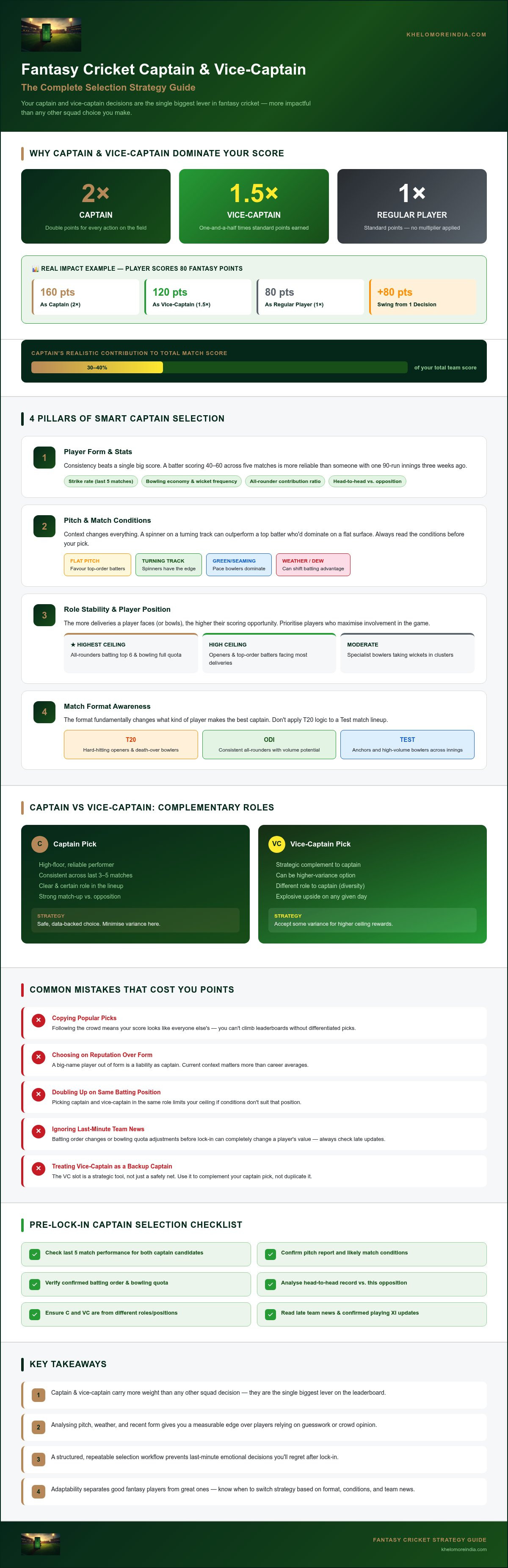
Before you can make smarter picks, you need to understand exactly what's at stake with these two slots. In fantasy cricket, your captain earns double the points for every action taken on the field, while your vice-captain earns 1.5 times the standard points. That gap between a brilliant captaincy call and a poor one isn't just a few points. It can be the difference between finishing in the top 10% of a contest and watching your rank collapse in the final overs.
Think about it this way: if a player scores 80 fantasy points in a match, they contribute 160 points as captain versus 80 as a regular squad member. That 80-point swing from a single selection decision dwarfs the impact of almost any other choice you make across your entire eleven.
Why Choosing the Right Captain Matters
Your captain can realistically contribute anywhere from 30 to 40 percent of your total match score, depending on the format and how the game unfolds. That's why applying solid fantasy cricket captain and vice captain tips isn't optional; it's the foundation of any competitive strategy.
Three factors consistently separate good captain picks from bad ones:
- Role stability: Openers and top-order batters face the most deliveries. All-rounders who bat in the top six and bowl full quota overs carry the highest point ceiling.
- Recent form: A player scoring consistently across their last three to five matches is more reliable than someone riding a single big innings.
- Match conditions: A flat batting pitch changes everything. A captain who's a spinner on a turning track can outperform a batter who'd dominate on a flat surface.
Ignoring any one of these factors is where most players go wrong. They focus on reputation rather than current context.
Understanding Vice-Captain Selection
Your vice-captain slot deserves just as much thought. A common mistake is treating it as a backup captain pick rather than a strategic complement. If your captain is a reliable, high-floor batter, your vice-captain can be a higher-variance option like a hard-hitting finisher or a wicket-taking bowler who could explode on any given day.
Avoid these pitfalls specifically:
- Doubling up on players from the same batting position, which limits your points ceiling if conditions don't suit that role
- Picking a vice-captain purely on popularity rather than match-specific upside
- Ignoring team news updates that might affect a player's batting order or bowling quota before lock-in
Mastering these fundamentals is where strong fantasy cricket captain and vice captain tips begin. The sections ahead will show you exactly how to apply this thinking to real match scenarios.
Key Strategies for Selecting Your Fantasy Cricket Captain
Knowing that your captain earns double points is one thing. Knowing who deserves that role on any given matchday is where the real work begins. The players who consistently top fantasy leaderboards aren't guessing. They're running through a repeatable checklist before every lock-in, and the four pillars below form the backbone of that process.
Analyzing Player Form and Stats
Recent form is your starting point, but you need to look beyond headline scores. A batter who hit 90 runs in one innings three weeks ago carries far less weight than someone scoring 40 to 60 consistently across their last five outings. Consistency signals reliability. That single big score might never repeat; steady contributions almost always do.
Key metrics worth tracking before finalising your captain pick:
- Strike rate in the last five matches: Particularly important in T20s, where a batter scoring at 140-plus consistently will rack up bonus points quickly.
- Bowling economy and wicket frequency: For bowler captains, look for players taking wickets in clusters rather than occasional breakthroughs.
- All-rounder contribution ratio: If a player is contributing meaningfully with both bat and ball in recent games, their points ceiling is significantly higher than a specialist.
- Head-to-head performance against the opposition: Some players have consistent records against specific teams or bowling attacks. This historical edge matters.
For reliable player data, sources like cricket match analysis and player performance from BBC Sport offer detailed match reports and form guides that go deeper than most fantasy app stat panels. Cross-referencing multiple sources before you commit is always a smart habit.
The Impact of Match Conditions
Conditions can flip your entire captain logic overnight. A player who looks like an obvious pick on paper can become a liability if the pitch or weather doesn't suit their game.
Pitch type is the most critical variable. Green, seaming tracks favour pace bowlers and make life difficult for strokeplayers. Dry, turning surfaces in cities like Chennai or Nagpur historically produce big returns for spinners. Flat batting decks, common at venues like Wankhede Stadium in Mumbai, tend to push the advantage firmly toward top-order batters and power hitters.
Weather matters too, particularly cloud cover. Overcast conditions assist swing bowling even on otherwise flat pitches, which can shift the value of a seam-bowling all-rounder considerably. Checking forecasts before your deadline isn't optional; it's standard practice among serious fantasy players.
Ground history adds another layer. Some venues consistently produce high-scoring games regardless of conditions, while others suppress totals. Looking at average first-innings scores and the typical run-rate at a specific ground gives you a realistic picture of how many points are actually available for your captain to earn.
Applying these fantasy cricket captain and vice captain tips in combination, rather than in isolation, is what separates a calculated pick from a hopeful one. For more structured guidance on building your full selection strategy, the resources available at KheloMore India's fantasy cricket strategy guides can help you develop a consistent pre-match routine.
Creating a Flexible Selection Process
Even the sharpest analysis means nothing if your process falls apart under time pressure. Most fantasy cricket players lose points not because they picked the wrong player, but because they rushed their final decisions without a clear workflow to lean on. Building a structured, repeatable selection process is what turns occasional good calls into consistent results across an entire season.
Pre-Match Checklist for Selection
Start your captain evaluation at least two to three hours before the lock-in deadline. This window gives you enough time to absorb team news without the panic of last-minute changes forcing a rushed decision. Work through these steps in order:
- Confirm playing XI announcements: Never finalise your captain before official squad confirmations. A key player resting or being dropped changes the entire selection picture.
- Check venue and pitch reports: Ground staff and match officials typically release pitch condition updates on the morning of the match. Cross-reference these with historical scoring data at that venue.
- Review injury and fitness updates: Social media channels for official team accounts are often the fastest source here. A player carrying a niggle may bat lower in the order or bowl fewer overs than expected.
- Assess opposition bowling attack: Your captain's value shifts depending on what they're facing. A batter who thrives against pace may struggle against a quality spin-heavy attack on a turning surface.
- Scan credible cricket player performance analysis from sources like BBC Sport: Expert pre-match commentary often surfaces details about player confidence, fitness, and tactical roles that raw statistics don't capture.
Applying these fantasy cricket captain and vice captain tips in a fixed sequence removes the guesswork from your pre-match routine and makes your decision-making far more reliable.
Post-Toss Adjustments
The toss is where your pre-match research meets reality. Batting or bowling first on a particular surface can completely reshape which players are positioned to score big. A captain you'd earmarked as a top pick might suddenly carry much lower upside if their team is chasing on a pitch that's expected to deteriorate.
Specifically, watch for these signals after the toss:
- Batting order confirmation: Some captains reveal their intended lineup during post-toss interviews. A batter pushed down the order due to match situation reduces their ceiling significantly.
- Late substitutions or impact player announcements: In formats that allow tactical substitutions, these decisions can shift the points distribution across your squad before a ball is bowled.
- Revised weather outlook: A shortened match due to rain changes everything. Fewer overs means fewer opportunities for your captain to accumulate points, so a player with a higher floor and faster scoring rate becomes more valuable than a steady accumulator.
Balancing risk against reward in those final minutes is genuinely difficult, but having a pre-set decision rule helps. If your captain pick's role is unchanged post-toss, stick with your original call. Only switch if there's a concrete, specific reason tied to the new information, not because of nerves or crowd opinion. That discipline is what separates reactive players from those who consistently apply strong fantasy cricket captain and vice captain tips with confidence. Resources like the strategy guides available at KheloMore India can help you build this kind of structured pre-match habit over time.
Overcoming Common Fears in Fantasy Cricket Selection
Even experienced fantasy cricket players feel it. That moment just before lock-in where doubt creeps in and you start second-guessing a captain pick you spent hours researching. This emotional side of selection is something most guides completely ignore, yet it's responsible for more poor decisions than bad research ever is.
The fear usually shows up in one of three forms: anxiety about picking a differential captain nobody else is choosing, reluctance to drop a big-name player who's been underperforming, or paralysis when last-minute team news throws your entire plan into question. Recognising which fear is affecting you in the moment is the first step toward making a cleaner decision.
Building Confidence in Your Choices
Confidence in captaincy decisions doesn't come from certainty about outcomes. It comes from trusting your process. If you've worked through your pitch analysis, checked team news, reviewed recent form, and cross-referenced your thinking against credible sources, your pick is already better informed than the majority of players in your contest.
A few techniques that genuinely help:
- Write down your reasoning before you lock in. A single sentence explaining why you chose your captain forces clarity and reduces the chance of an emotional, last-minute switch.
- Set a personal deadline. Commit to finalising your captain at least 30 minutes before the official cut-off. Decisions made under time pressure are almost always worse than those made with a clear head.
- Engage with the fantasy cricket community. Discussing your thinking with other players, whether in forums or group chats, often surfaces angles you hadn't considered. It also reminds you that everyone is working with the same uncertainty.
Applying strong fantasy cricket captain and vice captain tips consistently is far more valuable than chasing the perfect pick every single match. KheloMore India's fantasy cricket strategy guides can help you build the kind of structured thinking that makes confident selection a habit rather than a lucky streak.
Learning from Past Selections
Every poor captaincy call is genuinely useful if you treat it correctly. After each match, spend five minutes reviewing your pick against what actually happened. Don't just note that it went wrong. Ask specifically why your reasoning didn't hold up.
Was the pitch different from what reports suggested? Did a team news update arrive that you missed? Or did you override your research because of crowd opinion at the last minute? That distinction matters. A bad outcome from solid reasoning is just variance. A bad outcome from a flawed process is something you can fix.
Keep a simple log of your captain selections, your reasoning at the time, and the result. Patterns emerge quickly. Most players find they consistently make the same type of error, whether that's overvaluing reputation or ignoring venue history, and seeing it written down makes it far easier to correct. Losses stop feeling like failures when they start functioning as data.
Conclusion: Your Roadmap to Fantasy Cricket Success
Every strategy covered in this guide comes back to one central truth: your captain and vice-captain decisions carry more weight than anything else you do in fantasy cricket. Getting these two picks right, consistently and deliberately, is what separates players who occasionally top their leaderboards from those who do it week after week.
Here's a quick recap of what that looks like in practice:
- Prioritise role stability and recent form over reputation. A consistent performer across five matches beats a one-innings wonder every time.
- Let conditions guide your logic. Pitch type, ground history, and weather aren't background details; they're core inputs that can flip your entire captain shortlist.
- Follow a structured pre-match checklist. Confirm playing XIs, check pitch reports, review injury news, and always finalise your pick before the last-minute rush.
- Treat your vice-captain as a strategic complement, not a backup. A higher-variance pick in that slot can lift your ceiling without sacrificing your floor.
- Review every selection after the match. The patterns in your mistakes are more valuable than any single winning pick.
Adaptability is what ties all of this together. The best fantasy cricket managers don't have a fixed captain they back blindly across formats. They adjust their thinking based on whether it's a T20, an ODI, or a Test. They switch their approach when conditions change after the toss. They stay curious rather than comfortable.
That mindset is something you build over time, not something you arrive at after one good week. Applying strong fantasy cricket captain and vice captain tips is a habit, not a one-off decision. Each match gives you another data point, another opportunity to refine your process and sharpen your instincts.
If you're serious about improving your selections, the learning doesn't stop here. The fantasy cricket strategy guides available at KheloMore are designed to help you develop a consistent, research-backed approach to every aspect of team building, from squad selection all the way through to those crucial captaincy calls. Use them as a regular reference point, not just a one-time read.
Your next match is an opportunity. Go into it with a plan, trust your process, and keep building. That's the roadmap right there.
Take Your Fantasy Cricket Game Further in 2026
Captaincy decisions will always carry more weight than any other choice you make in fantasy cricket. The players who climb leaderboards consistently aren't luckier than everyone else; they're more deliberate. They check conditions, trust their research, and review what went wrong after every match.
Three things matter most as you move forward: building a pre-match routine you actually stick to, treating your vice-captain slot as a genuine strategic tool rather than an afterthought, and staying adaptable when formats or conditions shift your original thinking.
Applying strong fantasy cricket captain and vice captain tips isn't a one-match fix. It's a habit you sharpen over an entire season, one selection at a time.
If you want expert insights and comprehensive guides that support smarter decisions across every aspect of team building, explore more fantasy cricket tips on KheloMore. The resources there are built specifically to help you develop a consistent, research-backed approach rather than relying on guesswork.
Your next match is a fresh opportunity. Go in with a plan and back yourself.
Frequently Asked Questions About Fantasy Cricket Captain and Vice-Captain Selection
What factors should I consider when choosing a fantasy cricket captain?
Your captain decision should rest on four core inputs: the player's role stability (openers and top-order batters face more deliveries), their form across the last three to five matches, the pitch and weather conditions on match day, and their historical record against the specific opposition. No single factor should drive the call on its own.
Also confirm the playing XI before you lock in. A player who's been moved down the batting order or given a reduced bowling quota carries far less points potential than their reputation suggests. Checking official team announcements is a non-negotiable step before finalising your pick.
How often should I change my captain and vice-captain selections?
Change them as often as the match context demands it, not on a fixed schedule. If your previous captain is in strong form, conditions suit their game, and their role is unchanged, there's no reason to switch. Changing for the sake of variety is one of the most common mistakes fantasy players make.
The trigger for a change should always be a specific, concrete reason: a significant shift in conditions, a confirmed team news update, or a clear drop in recent form. Gut feeling and crowd opinion aren't valid reasons to abandon a well-researched pick.
Can I pick the same player as captain multiple times?
Absolutely, and in many cases you should. If a player is consistently delivering across formats, facing a favourable matchup, and holding a high-ceiling role in their team, backing them repeatedly is smart strategy rather than lazy thinking. Consistency in your process matters more than variety in your selections.
The key is that each repeat pick should be justified by fresh match-specific analysis, not habit. Run the same checklist every time. If that player still comes out on top after reviewing conditions, form, and team news, trust your process and back them again.
What if my captain is injured before the match?
Act immediately. Most fantasy platforms allow you to change your captain right up until the lock-in deadline, so monitor official team social media accounts and credible sports news sources closely in the hours before the match. Don't wait for the app to notify you; check proactively.
This is exactly why having a clear second choice ready before match day matters. As part of your pre-match routine, identify your top three captain options in ranked order. If your first pick is ruled out, you already know who steps up without scrambling for a last-minute decision under pressure.
How do match conditions affect player performance in fantasy cricket?
Conditions can completely reshape which players are worth captaining. A seaming pitch in overcast weather significantly boosts the value of pace-bowling all-rounders, while a dry, dusty surface in cities like Chennai historically rewards spinners. Flat batting decks at high-scoring venues push the advantage back toward top-order batters and power hitters.
Ground history adds useful context here. Average first-innings scores at a specific venue tell you how many points are realistically available, which helps you calibrate whether to back a steady accumulator or a higher-variance player with a bigger ceiling. Applying these fantasy cricket captain and vice captain tips around conditions is what turns a decent pick into a great one.
Are there specific players that are generally good captain choices?
All-rounders who bat in the top six and bowl a full quota of overs consistently offer the highest points ceiling across formats, because they have multiple ways to contribute in a single match. Players like this give you a higher floor than specialists, which is why they're frequently strong captain candidates regardless of conditions.
That said, no player is a universally safe pick across every match. An all-rounder who's been rested, is carrying a fitness concern, or is facing an opposition that neutralises their primary skill needs to be reassessed. Always evaluate the specific match context rather than defaulting to a name based on reputation alone.
How can I improve my fantasy cricket strategy over time?
Keep a simple match log. After every game, note your captain pick, the reasoning behind it, and what actually happened. Over a season, patterns in your decision-making become visible, whether that's consistently overvaluing certain player types or ignoring venue history. Seeing those patterns written down makes them far easier to correct than trying to recall them from memory.
Beyond self-review, engaging with credible strategy resources helps you develop a more structured approach. The fantasy cricket strategy guides available at KheloMore are built specifically to support this kind of ongoing improvement, giving you frameworks you can apply match after match rather than starting from scratch each time.
Common questions
What factors should I consider when choosing a fantasy cricket captain?
Your captain decision should rest on four core inputs: the player's role stability (openers and top-order batters face more deliveries), their form across the last three to five matches, the pitch and weather conditions on match day, and their historical record against the specific opposition. No single factor should drive the call on its own. Also confirm the playing XI before you lock in. A player who's been moved down the batting order or given a reduced bowling quota carries far less points potential than their reputation suggests. Checking official team announcements is a non-negotiable step before finalising your pick.
How often should I change my captain and vice-captain selections?
Change them as often as the match context demands it, not on a fixed schedule. If your previous captain is in strong form, conditions suit their game, and their role is unchanged, there's no reason to switch. Changing for the sake of variety is one of the most common mistakes fantasy players make. The trigger for a change should always be a specific, concrete reason: a significant shift in conditions, a confirmed team news update, or a clear drop in recent form. Gut feeling and crowd opinion aren't valid reasons to abandon a well-researched pick.
Can I pick the same player as captain multiple times?
Absolutely, and in many cases you should. If a player is consistently delivering across formats, facing a favourable matchup, and holding a high-ceiling role in their team, backing them repeatedly is smart strategy rather than lazy thinking. Consistency in your process matters more than variety in your selections. The key is that each repeat pick should be justified by fresh match-specific analysis, not habit. Run the same checklist every time. If that player still comes out on top after reviewing conditions, form, and team news, trust your process and back them again.
What if my captain is injured before the match?
Act immediately. Most fantasy platforms allow you to change your captain right up until the lock-in deadline, so monitor official team social media accounts and credible sports news sources closely in the hours before the match. Don't wait for the app to notify you; check proactively. This is exactly why having a clear second choice ready before match day matters. As part of your pre-match routine, identify your top three captain options in ranked order. If your first pick is ruled out, you already know who steps up without scrambling for a last-minute decision under pressure.
How do match conditions affect player performance in fantasy cricket?
Conditions can completely reshape which players are worth captaining. A seaming pitch in overcast weather significantly boosts the value of pace-bowling all-rounders, while a dry, dusty surface in cities like Chennai historically rewards spinners. Flat batting decks at high-scoring venues push the advantage back toward top-order batters and power hitters. Ground history adds useful context here. Average first-innings scores at a specific venue tell you how many points are realistically available, which helps you calibrate whether to back a steady accumulator or a higher-variance player with a bigger ceiling. Applying these fantasy cricket captain and vice captain tips around conditions is what turns a decent pick into a great one.
Are there specific players that are generally good captain choices?
All-rounders who bat in the top six and bowl a full quota of overs consistently offer the highest points ceiling across formats, because they have multiple ways to contribute in a single match. Players like this give you a higher floor than specialists, which is why they're frequently strong captain candidates regardless of conditions. That said, no player is a universally safe pick across every match. An all-rounder who's been rested, is carrying a fitness concern, or is facing an opposition that neutralises their primary skill needs to be reassessed. Always evaluate the specific match context rather than defaulting to a name based on reputation alone.
How can I improve my fantasy cricket strategy over time?
Keep a simple match log. After every game, note your captain pick, the reasoning behind it, and what actually happened. Over a season, patterns in your decision-making become visible, whether that's consistently overvaluing certain player types or ignoring venue history. Seeing those patterns written down makes them far easier to correct than trying to recall them from memory. Beyond self-review, engaging with credible strategy resources helps you develop a more structured approach. The fantasy cricket strategy guides available at KheloMore are built specifically to support this kind of ongoing improvement, giving you frameworks you can apply match after match rather than starting from scratch each time.