Fantasy Cricket Points System: 2026 Complete Guide
Master the fantasy cricket points system explained for 2026. Learn batting, bowling, and bonus scoring to build winning T20, ODI & Test teams.

Why does a bowler with three wickets often outscore a batsman who just smashed a half-century? It seems backwards until you realize that winning isn't just about picking the most famous players; it's about picking the ones whose real-world performance matches the specific scoring rules. You've likely felt that frustration when your captain hits a solid 40 runs but ends up with a lower total than a bowler who grabbed two quick wickets. This fantasy cricket points system explained guide for 2026 is here to end that confusion and help you build teams with much higher winning potential.
We understand the headache of losing a match because of unexpected strike rate penalties or failing to see why a wicket is weighted so much higher than 25 runs. You need a clear mental framework to evaluate every player before the toss. We'll break down the essential differences between T20, ODI, and Test point weights so you never miss a bonus again. You'll also learn how to maximize your captaincy multipliers to ensure your squad is optimized for every single ball bowled.
Key Takeaways
- Understand how to translate on-field actions into digital scores by mastering the "Core Four" scoring categories: batting, bowling, fielding, and bonuses.
- Identify high-value players by learning how strike rate and economy rate bonuses reward aggressive batting and disciplined bowling.
- Get the fantasy cricket points system explained for 2026 to see why wicket-taking ability and boundary milestones are critical for your team's success.
- Learn to adapt your squad selection for different formats, from high-risk T20 strategies to the balanced approach needed for ODI and Test matches.
- Boost your winning potential by using player point history and verifying the final Playing XI after the toss to avoid wasted spots.
Understanding the Fantasy Cricket Points System in 2026
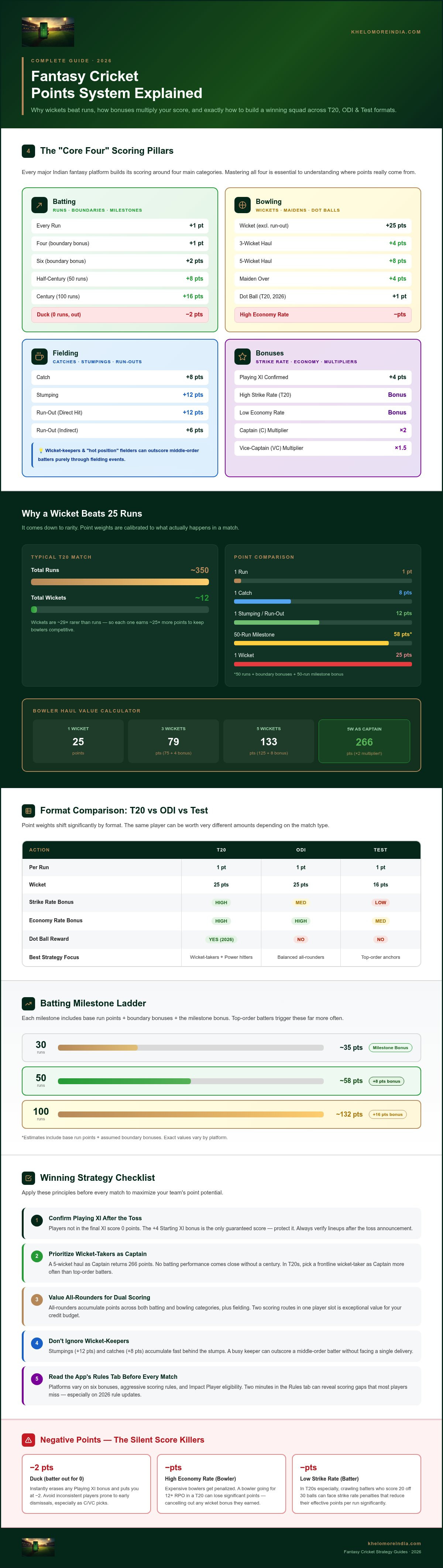
At its heart, a fantasy cricket points system is a mathematical bridge. It turns every boundary, wicket, and catch on the physical field into a digital score that determines your rank in a contest. While it might look like a wall of numbers at first, having the fantasy cricket points system explained simply shows that the logic is actually quite consistent across the industry. Most major Indian platforms build their scoring around four main pillars, often called the "Core Four."
- Batting: Points earned for every run, with extra rewards for fours, sixes, and reaching milestones like a half-century or a hundred.
- Bowling: Points for every wicket taken (excluding run-outs), along with bonuses for maiden overs or maintaining a low economy rate.
- Fielding: Points for catches, stumpings, and direct or indirect run-outs.
- Bonuses: Specialized points for high strike rates in T20s or for being the player of the match.
Don't overlook the "Starting 11" points. In 2026, most apps still award 4 points just for a player being in the final announced lineup. It's the only guaranteed scoring you'll get, which is why checking the toss is the most basic but vital step in your strategy. If your player doesn't take the field, they stay at zero, and your team's winning potential drops immediately.
The Logic of Point Weighting: Why Wickets Beat Runs
Wickets are the gold standard of fantasy points. If you've ever wondered why a single wicket is often worth 25 points while a run is only worth 1, it comes down to rarity. In a standard T20 match, there might be 350 runs but only 12 wickets. Point systems are designed to balance the game so that a specialist bowler can compete with a top-order batter. The Point-to-Value ratio is the foundational metric used to determine if a player's cost in credits is worth their projected scoring output.
Platform Variations: Standard vs. Aggressive Scoring
While the basics stay the same, the details often change between apps. Some platforms offer aggressive scoring, giving higher bonuses for sixes or consecutive boundaries. In 2026, the "Impact Player" rule has also changed how we look at point accumulation. If a player is subbed in, they can still rack up massive points, but you have to be certain they'll actually take the field before you commit. Always spend two minutes reading the "Rules" tab on your specific app before the match starts; a small difference in boundary bonuses can be the gap between first place and a losing team.
Breaking Down Core Scoring Categories: Batting, Bowling, and Fielding
To build a winning squad, you need to look beyond the total score and understand the individual triggers that generate points. While we have already seen how the fantasy cricket points system explained in the previous section balances the game, the real magic happens in the specific categories. Knowing these numbers helps you choose between a steady anchor and a risky power-hitter.
- Batting: Every run typically earns you 1 point. However, boundaries are the real prize. A four usually adds a +1 bonus, while a six can add +2. These small increments add up quickly in high-scoring matches.
- Bowling: A single wicket remains the most valuable standard event, usually worth 25 points. In 2026, many platforms also reward dot balls in T20s, making defensive bowlers more viable than they used to be.
- Fielding: Catches (8 points), stumpings (12 points), and run-outs (12 points for a direct hit) are often overlooked. A busy wicket-keeper or a fielder at "hot" positions like long-on can easily outscore a middle-order batter.
Negative points can ruin a perfect lineup. A "Duck" penalty usually deducts 2 points from your total. Similarly, if a bowler's economy rate climbs too high or a batter's strike rate drops too low, you'll see your hard-earned points vanish. For more detailed insights on player selection, you can browse our fantasy cricket strategy guides to refine your approach.
Batting Milestones: The Importance of Longevity
Milestones are where the elite scorers pull away from the pack. Reaching 30, 50, or 100 runs triggers significant bonuses that can sometimes double a player's base value. For instance, a century bonus might add 16 points on top of the 100 points for the runs. This is why top-order batters are so popular; they simply have more time at the crease to trigger these high-value milestones. Avoid players with a high "Duck" frequency, as that -2 penalty often comes with a missed opportunity for any positive points.
Bowling and Fielding: Beyond the Wickets
Don't just hunt for wicket-takers. Maiden overs are absolute gold mines in T20 fantasy cricket, often rewarding you with 8 to 12 points for just six balls. If a bowler picks up a three-wicket haul, they usually get an extra bonus, which jumps significantly for a five-wicket haul. Wicket-keepers are perhaps the most efficient point earners in the game. They combine the potential for batting runs with constant opportunities for catches and stumpings, making them excellent candidates for your squad's backbone.
The Power of Bonuses: Strike Rates, Economy Rates, and Multipliers
While basic runs and wickets provide the foundation, the real separation in leaderboards happens through bonuses and multipliers. Having the fantasy cricket points system explained often stops at the surface level, but the 2026 landscape requires a deeper look at efficiency. A player who scores 30 runs off 15 balls is often more valuable than one who scores 40 runs off 40 balls due to strike rate bonuses and the avoidance of penalties. These "hidden" points are what allow savvy players to climb the rankings even when their core stats look similar to the competition.
The 2026 "Impact Player" rule has also added a layer of complexity to point accumulation. Substitutes can now earn full points for any contribution they make once they enter the game. This means you need to track which tactical subs are likely to be used. A late-innings finisher who faces only 10 balls can still swing a contest through high-intensity scoring and boundary bonuses, provided they meet the minimum ball requirements for their strike rate to be calculated.
Maximizing the Captain and Vice-Captain Choice
Your Captain and Vice-Captain choices are the most critical decisions you'll make. The Captain earns 2x points, while the Vice-Captain gets 1.5x. This math means if your captain scores 60 points, you actually net 120. It's usually safest to pick a top-order batter or a dominant all-rounder who contributes in both innings. To master these specific roles, check out our guide on Fantasy Cricket Captain and Vice-Captain Tips for Winning Strategies in 2026. Picking an all-rounder as captain is a classic "double-dip" strategy, as they can earn 2x points from both a three-wicket haul and a quick-fire thirty.
Strike Rate and Economy Rate Penalties
Don't fall into the "Negative Point" trap by ignoring efficiency. Strike rate and economy rate aren't just statistics; they're active point triggers. In T20 matches, a strike rate above 170 typically nets you a +6 bonus. Conversely, if a batter crawls at a strike rate below 100 after playing at least 10 balls, they'll lose points. The same applies to bowlers. A "miserly" spell with an economy under 5.0 in a T20 can earn you a +6 bonus, which is effectively worth half a wicket. Avoid "anchor" batters in high-scoring matches, as their slow scoring can actually hurt your total score through SR penalties.
Format Variations: How Points Shift from T20 to Test Cricket
You can't use a T20 mindset to win a Test match contest. While the foundational rules of the fantasy cricket points system explained earlier remain the same, the weighting of those points shifts dramatically to match the pace of each format. In T20s, every ball is an event. In Tests, endurance and discipline are what the scorers reward. If you don't adjust your selection criteria based on the number of overs, you'll likely find your team lagging behind more adaptable players.
The primary difference lies in how platforms handle the volume of play. In a T20, a bowler only has 24 balls to make an impact. In a Test match, that same bowler might bowl 500 balls. If every run or wicket carried the same weight across all formats, Test match scores would reach the thousands, making them impossible to compare or balance. To stay ahead, you can use our fantasy cricket strategy guides to see format-specific checklists for your next draft.
T20 vs. ODI: The Subtle Differences
T20 strategy is built on high-risk, high-reward actions. Boundary bonuses are the lifeblood of this format. A six in a T20 is often worth more than a six in an ODI because of the immediate impact on the game's momentum. All-rounders are the undisputed kings here. They give you multiple paths to points in a game where specialist batters might only face a handful of deliveries. In the 50-over ODI format, strike rate becomes less critical for middle-order players. You want accumulators who can reach the 50 or 100-run milestones, as these bonuses are more attainable with more time at the crease.
The Unique World of Test Match Fantasy
Test cricket scoring is a different beast entirely. Many platforms award points for "every 10 runs" rather than every single run to prevent scores from inflating. However, "Playing Time" and "Maiden Overs" become huge factors. A bowler who can tie down an end with maiden after maiden will rack up points that aren't even available in shorter formats. Fielding points also take a turn. While outfielders get the most catches in T20s, slip catchers and short-leg fielders are high-value targets in Tests. A specialist slip fielder who grabs three catches in an innings can outscore a batter who makes a quick 40. Five-wicket haul bonuses are also massive in this format, often providing a point jump that can single-handedly win you a league.
Bowlers generally matter more in longer formats because they have the opportunity to bowl multiple spells. In a T20, a bad first over can end a bowler's night. In a Test, they can return with a fresh ball and a new plan. When building your Test squad, prioritize wicket-taking consistency over raw pace or economy.
From Points to Podium: Building Your Winning Fantasy Strategy
You've got the fantasy cricket points system explained in detail, but knowledge without action won't get you to the top of the leaderboard. Strategic winners don't just look at famous names; they look at patterns. By analyzing a player's point history over their last five matches, you can identify "value picks." These are the under-the-radar players with low credit costs who consistently trigger boundary or economy bonuses. These players are the budget-friendly engines that allow you to afford expensive superstars in the same squad.
Accuracy is your best friend. Always wait for the official team announcement after the toss. In 2026, with squads becoming more flexible, a "sure starter" might suddenly be rested or replaced by an Impact Player. Checking the Playing XI ensures you don't carry a zero-point player who ruins your average. It's a simple step, but it's the most common mistake beginners make. One empty slot can be the difference between winning a contest and losing your entry fee.
Researching Before the Match
Pitch reports are the ultimate decider for point weighting. A dry, cracked surface in Chennai means you should load up on spinners who can rack up bowling and maiden over points. Conversely, a flat track at the Wankhede demands a batting-heavy lineup to capitalize on boundary bonuses. For a step-by-step guide on what to look for, check our Best Fantasy Cricket Picks Today: The Ultimate 2026 Selection Checklist. Recent form remains the most reliable indicator; a player in a "purple patch" is far more likely to hit those high-value milestones than a struggling veteran.
The KheloMore Advantage
KheloMore India is here to act as your trusted advisor. We believe that understanding the nuances of sports shouldn't be a struggle for Indian families. Our mission is to make every aspect of the game, from booking a local ground to mastering a fantasy cricket points system explained in simple terms, accessible for everyone. We provide the research and the tools so you can make informed decisions with confidence. Before your next match starts, take five minutes to review your squad against the scoring rules we've discussed. It's the small adjustments that turn a casual player into a consistent winner.
Master the Game and Claim Your Podium Spot
Winning at fantasy cricket in 2026 isn't about luck; it's about making the math work for you. By now, you've seen the fantasy cricket points system explained through the lens of rarity, format variation, and efficiency bonuses. You know that a well-timed wicket or a high strike rate can often be more valuable than a slow-paced half-century. These small details are what separate casual players from the experts who consistently lead the rankings.
Success comes down to your pre-match preparation and your ability to adapt to the pitch and the toss. Use our independent expert analysis and comprehensive 2026 strategy updates to refine your team selection every single day. We provide practical guides for Indian sports fans to ensure you stay ahead of the curve. Ready to take your strategy to the next level? Explore more fantasy cricket insights on KheloMore India and start building your winning squad today. The field is ready, and now you have the knowledge to conquer it.
Frequently Asked Questions
How much is 1 run worth in fantasy cricket points?
In most 2026 fantasy cricket apps, 1 run is worth exactly 1 point. However, this base value is often boosted by boundary bonuses, such as +1 point for a four or +2 points for a six. Milestones like 30, 50, or 100 runs also add extra points to your player's total score.
Do players get points for run-outs in all fantasy apps?
Yes, almost all major fantasy platforms award points for run-outs. Typically, a direct hit earns more points, often 12, compared to an indirect run-out where two players are involved. In those cases, the points are usually split, with 6 points going to each player. It's a great way for agile fielders to contribute to your score even if they don't get to bat or bowl.
What happens if my captain does not play in the actual match?
If your captain isn't in the starting XI or doesn't enter as an impact player, you'll receive zero points for that position. Since the 2x multiplier applies to the captain's score, having a non-playing captain is a major disadvantage. Always check the final Playing XI after the toss to swap out any inactive players before the match starts.
Is the points system the same for IPL and International matches?
The core points system usually remains the same across T20 leagues like the IPL and International T20s. However, the system changes significantly when shifting to ODIs or Test matches. As this fantasy cricket points system explained guide highlights, you should always check the specific rules for each match type to understand how weights shift for different formats.
Can a player get negative points in fantasy cricket?
Yes, players can definitely earn negative points. Common reasons include getting out for a "Duck," which usually deducts 2 points, or having a very high economy rate as a bowler. Penalties are also applied if a batter has a very low strike rate after facing a minimum number of balls. These rules are designed to reward efficiency and punish poor on-field performances.
How are points calculated for a Super Over?
Points earned during a Super Over are not counted in your fantasy total on most platforms. Only the performances during the standard 20 or 50 overs are calculated. If a match goes to a Super Over, your players' scores will stay exactly as they were at the end of the second innings. This is a standard rule across almost all major Indian fantasy apps.
Do substitute players earn points if they come on the field?
In the 2026 season, "Impact Players" or substitutes do earn points if they actively participate in the match. They receive points for any runs scored, wickets taken, or catches made once they are officially subbed in. However, they usually don't get the "Starting 11" points that the initial lineup receives at the beginning of the game.
What is the most important category for earning points: batting or bowling?
Both are vital, but bowling is often considered more consistent because a single wicket is worth 25 points. This is equivalent to a batter scoring 25 runs. A bowler can also earn maiden over and economy bonuses that add up quickly. However, top-order batters have the highest ceiling for massive scores if they hit a century, making a balanced team the best strategy for winning.
Common questions
How much is 1 run worth in fantasy cricket points?
In most 2026 fantasy cricket apps, 1 run is worth exactly 1 point. However, this base value is often boosted by boundary bonuses, such as +1 point for a four or +2 points for a six. Milestones like 30, 50, or 100 runs also add extra points to your player's total score.
Do players get points for run-outs in all fantasy apps?
Yes, almost all major fantasy platforms award points for run-outs. Typically, a direct hit earns more points, often 12, compared to an indirect run-out where two players are involved. In those cases, the points are usually split, with 6 points going to each player. It's a great way for agile fielders to contribute to your score even if they don't get to bat or bowl.
What happens if my captain does not play in the actual match?
If your captain isn't in the starting XI or doesn't enter as an impact player, you'll receive zero points for that position. Since the 2x multiplier applies to the captain's score, having a non-playing captain is a major disadvantage. Always check the final Playing XI after the toss to swap out any inactive players before the match starts.
Is the points system the same for IPL and International matches?
The core points system usually remains the same across T20 leagues like the IPL and International T20s. However, the system changes significantly when shifting to ODIs or Test matches. As this fantasy cricket points system explained guide highlights, you should always check the specific rules for each match type to understand how weights shift for different formats.
Can a player get negative points in fantasy cricket?
Yes, players can definitely earn negative points. Common reasons include getting out for a "Duck," which usually deducts 2 points, or having a very high economy rate as a bowler. Penalties are also applied if a batter has a very low strike rate after facing a minimum number of balls. These rules are designed to reward efficiency and punish poor on-field performances.
How are points calculated for a Super Over?
Points earned during a Super Over are not counted in your fantasy total on most platforms. Only the performances during the standard 20 or 50 overs are calculated. If a match goes to a Super Over, your players' scores will stay exactly as they were at the end of the second innings. This is a standard rule across almost all major Indian fantasy apps.
Do substitute players earn points if they come on the field?
In the 2026 season, "Impact Players" or substitutes do earn points if they actively participate in the match. They receive points for any runs scored, wickets taken, or catches made once they are officially subbed in. However, they usually don't get the "Starting 11" points that the initial lineup receives at the beginning of the game.
What is the most important category for earning points: batting or bowling?
Both are vital, but bowling is often considered more consistent because a single wicket is worth 25 points. This is equivalent to a batter scoring 25 runs. A bowler can also earn maiden over and economy bonuses that add up quickly. However, top-order batters have the highest ceiling for massive scores if they hit a century, making a balanced team the best strategy for winning.