How to Evaluate a Sports Coach in India: The Ultimate Parent’s Checklist for 2026
Learn how to evaluate sports coach India options with our 2026 checklist. We help parents assess certifications, safety, and teaching skills for your child's...

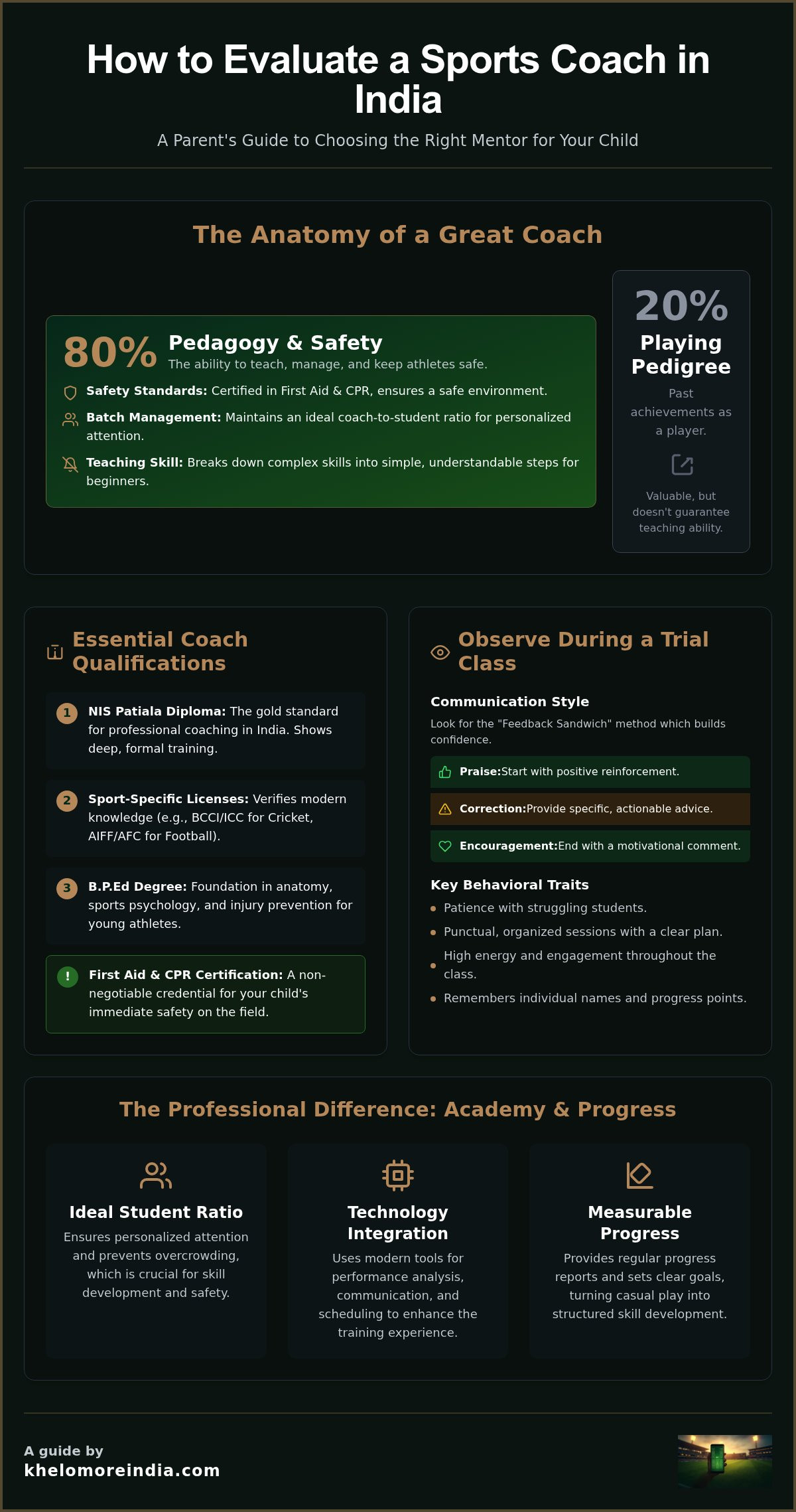
A coach's playing pedigree is only 20% of the equation, while the remaining 80% is their pedagogy, safety standards, and batch management. It's natural to feel anxious about how to evaluate sports coach India options when the local market is growing so rapidly. You aren't just looking for a trainer; you're looking for someone who keeps your child safe from injury and provides actual value for your hard-earned money.
We understand the confusion caused by varying certification levels and the fear of wasting time at sub-par academies. This guide gives you a clear framework to judge a coach's performance during a trial session. You'll learn which certifications actually matter in 2026, from the latest NSNIS diploma requirements to the new National Coach Accreditation Board (NCAB) standards. We're providing a concrete checklist to help you choose a long-term mentor who uses a modern, practice-based approach to help your child thrive.
Key Takeaways
- Distinguish between a former player's talent and a coach's ability to teach by verifying NIS certifications and professional credentials.
- Learn how to evaluate sports coach India options by observing their temperament and communication style during a live trial session.
- Identify the ideal coach-to-student ratio and safety protocols necessary to prevent injuries and ensure personalized attention for your child.
- Discover how professional mentors use technology and regular progress reports to turn casual play into measurable skill development.
- Use our comprehensive trial class checklist to ask the right questions before committing to a long-term academy membership.
Evaluating Professional Qualifications: Beyond the Playing Career
Many parents in India assume that a shelf full of trophies makes someone an expert mentor. While playing experience is valuable, it doesn't always translate to effective instruction. When you're learning how to evaluate sports coach India academy options, you need to look for credentials that prove they understand the science of teaching. A former Ranji player might have the skills, but a certified professional has the training to communicate those skills to a child who's never held a bat.
The role of a coach extends far beyond showing off a perfect cover drive; it involves managing psychological development and physical safety. This is why a Bachelor of Physical Education (B.P.Ed) is so valuable. It provides a foundation in anatomy, sports psychology, and teaching methods. If a coach has this degree, they've spent years studying how the human body moves and grows, which is vital for preventing long-term injuries in young athletes.
Top Certifications to Look for in India
NIS Patiala diplomas remain the gold standard across the country. These intensive programs, particularly the Diploma in Sports Coaching, are the most recognized qualifications for professional roles in 2026. You should also look for sport-specific licenses that show local and international relevance. For cricket, check for ICC or BCCI Level 1, 2, or 3 certifications. For football, look for AIFF or AFC licenses. Generally, Level 1 is for grassroots training, while higher levels indicate specialization for elite play. Finally, verify that the coach holds a current First Aid and CPR certification. In a high-impact environment, these skills are non-negotiable for your child's safety.
The Playing Pedigree Trap
Don't let a star player's reputation blind you to poor instruction. A great coach is defined by the success of their students, not their own past glory. When you observe a session, ask yourself if the coach can explain the "why" behind a drill. Coaching Pedagogy is the ability to break down complex movements for beginners. If a coach gets frustrated when a child doesn't "just get it," they likely lack this pedagogical training. High-level players often find basic skills so intuitive that they struggle to teach them to someone starting from scratch.
Understanding how to evaluate sports coach India standards means looking at the track record of their current batch. Are the students improving? Do they look confident? Those are the real trophies you should be hunting for when choosing a mentor for your child.
Observing On-Field Behavior: Communication and Temperament
Watching a trial class is your best opportunity to see a mentor's true personality. Technical knowledge is vital, but the way a coach delivers that knowledge determines if your child stays motivated or quits within a month. When you're learning how to evaluate sports coach India options, pay close attention to how the coach treats the student who is struggling the most. It's easy to coach a natural athlete, but a true professional shows patience and provides specific, actionable advice to the child who can't yet catch the ball or hit a straight drive.
Professionalism also shows in the small details. Does the session start and end on time? A coach who is consistently late or finishes early is essentially wasting your training budget. Organization matters just as much. If the coach spends twenty minutes of a one-hour session just looking for cones or setting up nets, the batch is poorly managed. Look for a structured plan where drills flow logically from one to the next without long periods of standing around.
The Language of Coaching
Instructions must be clear, age-appropriate, and delivered in a language your child fully understands. If a coach uses complex technical jargon that leaves an eight-year-old looking confused, they aren't effectively teaching. Look for the "Feedback Sandwich" technique during the session. This involves praising a specific effort, providing a correction, and ending with an encouraging remark. This framework for evaluating coaches emphasizes that positive reinforcement builds long-term confidence, whereas constant criticism often leads to burnout and a loss of interest in the sport.
Engagement and Enthusiasm
A coach's energy sets the tone for the entire batch. Are they actively moving around the field, or are they standing in the shade with a whistle? Check if they remember individual names and specific areas of improvement for each child. A coach who calls out "Good footwork, Rahul!" shows they are invested in every child's individual progress. High-quality mentors maintain this energy even during the final fifteen minutes of a session when fatigue usually sets in for the students. You can use KheloMore India's resources to find academies that prioritize these high engagement standards.
Discipline management is the final piece of the puzzle. Observe how the coach handles distractions or misbehavior. A professional doesn't resort to shouting or humiliation; they use firm, constructive redirection to get the group back on track. Understanding how to evaluate sports coach India standards requires you to look for this balance of authority and empathy, ensuring a safe and productive learning environment for your child.
Logistics and Infrastructure: The "Academy" Factor
A great coach needs a supportive environment to be effective. While we focus on credentials, the physical state of the academy often reveals the coach's commitment to excellence. When you're learning how to evaluate sports coach India facilities, start by looking at the equipment. Rusted poles, frayed nets, or worn-out mats aren't just signs of neglect; they're safety hazards. A professional setup includes well-maintained gear and a clear emergency action plan. Ask to see the first-aid kit. If it's buried under old jerseys or missing basic supplies, the academy isn't prepared for the reality of youth sports.
The harsh Indian sun is another factor parents often overlook. Does the facility provide enough shade for breaks? Is there a clean, accessible source of drinking water? Heat exhaustion is a serious risk during summer months. A coach who prioritizes hydration and schedules breaks in the shade demonstrates a level of care that goes beyond technical drills. These logistical details are the foundation of a safe training environment. You can't expect a child to perform at their best if they're dehydrated or playing on uneven, dangerous turf.
Batch Size and Individual Attention
The most talented mentor in the world can't help your child if they're managing thirty students at once. You must prioritize the cricket academy coach to student ratio as a non-negotiable metric. For beginners, a 1:10 ratio is the absolute limit for meaningful progress. As your child advances, look for ratios closer to 1:6. This ensures the coach can spot technical flaws before they become bad habits. Always verify if the head coach listed on the banner is actually on the field. Many academies use a famous name to attract parents but leave the actual training to inexperienced assistants who lack proper pedagogical training.
Facility Hygiene and Safety
Safety extends to the playing surface itself. Uneven turf or poor lighting can lead to avoidable ankle injuries. The Official Coaching Development Framework introduced by the government highlights the need for standardized safety and infrastructure across Indian academies. Beyond the field, check the hygiene of washrooms and changing areas. These facilities should be clean and safe for children. Finally, talk to the academy manager. A professional manager handles logistics and parent queries efficiently, allowing the coach to focus entirely on the students. This organizational structure is a hallmark of a top-tier academy. Learning how to evaluate sports coach India programs means looking at the whole ecosystem, not just the drills.
Progress Tracking: How a Professional Coach Measures Success
Coaching isn't just about what happens during the hour on the field. It's about what changes over months of training. When you're figuring out how to evaluate sports coach India academy outcomes, ask to see a sample progress report. A professional mentor shouldn't just give vague verbal feedback like "he's doing well." They should provide specific data on skill acquisition, fitness levels, and areas needing work every month or quarter. Regular parent-coach meetings are essential. These sessions ensure you and the coach are aligned on your child's long-term journey.
By 2026, technology is no longer just for elite athletes. In the Indian sports market, which is projected to reach USD 462.13 Million by 2034, analytics is becoming a standard coaching tool. Check if the coach uses video analysis to correct form or wearable trackers to monitor intensity. Seeing themselves on screen helps children understand technical flaws much faster than verbal cues alone. Data-driven feedback removes the guesswork from development. You can find more detailed advice on choosing the right environment in our Sports Booking Guides, which help you compare academy standards across India.
The Curriculum Approach
A professional academy doesn't just "play a match" every day. Look for a structured lesson plan that balances technical drills with match application. Drills build the foundation, while matches teach students how to apply those skills under pressure. The coach should have a clear plan for how a student transitions from a beginner batch to an intermediate or advanced level. If every session feels like a random game or a casual knock without a specific goal, your child isn't following a real development pathway. Understanding how to evaluate sports coach India standards means looking for this methodical progression.
Holistic Development
True mentorship goes beyond the boundaries of the field. A professional coach in India should treat the student as an athlete, not just a client. This means discussing nutrition, sleep hygiene, and mental toughness as part of the regular curriculum. They should also focus on essential "soft skills" like teamwork, leadership, and how to handle a tough defeat with grace. These life lessons are often more valuable than the sport itself. A coach who ignores the psychological side of the game is only doing half the job. Look for a mentor who builds character alongside physical talent.
The Final Decision: The Trial Class Checklist
Don't commit thousands of rupees to an academy based on a glossy brochure or a famous name. A trial class is non-negotiable. It's the only way to see if the coach's style matches your child's personality. When you're finalizing how to evaluate sports coach India academy options, the trial class acts as your ultimate filter. Watch your child's face after the session. Are they buzzing with excitement, or do they look intimidated? If they're hesitant to return, it doesn't matter how many certifications the coach has. The chemistry between a mentor and a student is what keeps them coming back day after day.
Before you make a payment, use the KheloMore 2026 guide to sports booking to verify the academy's operational standards. Comparing at least two or three local options side-by-side gives you a much clearer perspective on what quality training looks like. Seeing different coaching styles in a single week helps you spot red flags that you might miss if you only visit one center.
5 Essential Questions for the Head Coach
Direct communication is vital during your first interaction. Don't be afraid to ask tough questions. A professional mentor will appreciate your interest in your child's development. Use these four questions to gauge their transparency:
- "What is your specific plan for a beginner in their first three months?" Look for a structured progression, not just random games.
- "How do you handle injuries or medical emergencies during a session?" They should have a clear protocol and a stocked first-aid kit.
- "What is the exact coach-to-student ratio for this specific batch?" Ensure it matches the standards we discussed in section three.
- "Can I see your coaching certifications or federation affiliation?" A legitimate coach will be happy to share their credentials.
Making the Booking via KheloMore
The KheloMore app simplifies the final steps by providing a bridge between parents and verified data. You can read reviews and ratings from other Indian parents who have already tested the academy. This transparency helps you avoid academies that look great on paper but fail in practice. Always check the refund and cancellation policy within the app before you confirm your spot. You can also set up preferences to get notifications for new batches and trials. This ensures you're always informed about the best opportunities in your neighborhood. Learning how to evaluate sports coach India standards is easier when you have the right tools to compare your options fairly.
Empowering Your Young Athlete with the Right Mentor
Choosing the right mentor is the most significant investment you'll make in your child's athletic journey. By prioritizing professional certifications like the NIS diploma and observing real-time communication during trial sessions, you move past the common playing pedigree trap. You now have a concrete framework for how to evaluate sports coach India academy options by looking at safety protocols, student-to-coach ratios, and structured progress tracking. This methodical approach ensures your child's time on the field is both productive and safe.
The right environment doesn't just build technical skills; it builds the confidence and character your child will carry for a lifetime. You don't have to navigate this complex sports ecosystem alone. Use our platform to access verified coach profiles and real parent reviews to make an informed choice that fits your family's needs perfectly. We're here to help you bridge the gap between confusion and athletic success.
Find and book a verified sports academy near you on KheloMore to enjoy secure online booking and receipts. Take the guesswork out of your child's development and give them the professional start they deserve. Let's get them moving toward their goals today.
Frequently Asked Questions
Is it mandatory for a sports coach in India to have an NIS certification?
No, it isn't legally mandatory for coaches in private academies to hold an NIS certification. However, a diploma from the Netaji Subhas National Institute of Sports (NSNIS) is the most recognized qualification for professional roles in India. While many private trainers rely on playing experience, an NIS-certified coach has formal training in sports science, anatomy, and injury prevention, making them a safer choice for foundational training.
What is a reasonable coach-to-student ratio for a cricket academy in India?
A ratio of 1:10 is the gold standard for beginners to ensure each child receives personalized feedback. As players move into advanced batches, this ratio should ideally drop to 1:6 to allow for intensive technical work and video analysis. If you see a single coach managing a batch of 20 or 30 students, it's a sign that your child won't get the individual attention they need to improve.
How much should I expect to pay for a professional sports coach in India?
Monthly fees for local city-based sports camps in 2026 generally range between ₹5,000 and ₹12,000. Elite residential programs or specialized clinics can cost significantly more, sometimes reaching up to ₹75,000 for intensive summer sessions. These costs usually depend on the coach's credentials, the academy's infrastructure, and the specific sport's equipment requirements.
Can I ask for a refund if the coach I signed up for is never present?
Yes, you have the right to request a refund if the academy fails to provide the specific coach or service promised during signup. When you're researching how to evaluate sports coach India options, always read the fine print regarding cancellations and substitutions. Using a platform that provides secure receipts and clear refund policies protects your investment if the academy doesn't meet its professional obligations.
What is the difference between an assistant coach and a head coach in most academies?
The head coach is responsible for designing the overall curriculum and tracking the long-term progress of the students. Assistant coaches typically lead the daily drills and manage smaller groups during practice. It's vital to ensure the head coach is actually present on the field to supervise the assistants, rather than just acting as a name on the academy's banner.
Should I choose a coach based on their former playing level or their coaching experience?
You should prioritize coaching experience and pedagogical training over a high playing rank. A former professional player might have great skills but may struggle to explain basic movements to a beginner. A coach with a B.P.Ed degree or federation-specific licenses has studied how to teach, which is more valuable for a child's early development than a shelf full of the coach's personal trophies.
How do I know if a sports academy is officially recognized by the Indian government?
Look for affiliations with state-level sports associations or national federations like the BCCI for cricket or AIFF for football. You can also check if the academy is registered under the Khelo India program or recognized by the Sports Authority of India (SAI). Official recognition usually ensures the facility follows specific safety standards and participates in sanctioned tournaments.
What should be in a basic first-aid kit at a sports academy?
A standard kit must include antiseptic liquid, sterile gauze, medical tape, and adhesive bandages of various sizes. It's also essential to have instant cold packs for managing sprains and tweezers for minor debris. Knowing how to evaluate sports coach India safety standards involves checking that this kit is always stocked and kept in a place that is easily accessible during every training session.
Common questions
Is it mandatory for a sports coach in India to have an NIS certification?
No, it isn't legally mandatory for coaches in private academies to hold an NIS certification. However, a diploma from the Netaji Subhas National Institute of Sports (NSNIS) is the most recognized qualification for professional roles in India. While many private trainers rely on playing experience, an NIS-certified coach has formal training in sports science, anatomy, and injury prevention, making them a safer choice for foundational training.
What is a reasonable coach-to-student ratio for a cricket academy in India?
A ratio of 1:10 is the gold standard for beginners to ensure each child receives personalized feedback. As players move into advanced batches, this ratio should ideally drop to 1:6 to allow for intensive technical work and video analysis. If you see a single coach managing a batch of 20 or 30 students, it's a sign that your child won't get the individual attention they need to improve.
How much should I expect to pay for a professional sports coach in India?
Monthly fees for local city-based sports camps in 2026 generally range between ₹5,000 and ₹12,000. Elite residential programs or specialized clinics can cost significantly more, sometimes reaching up to ₹75,000 for intensive summer sessions. These costs usually depend on the coach's credentials, the academy's infrastructure, and the specific sport's equipment requirements.
Can I ask for a refund if the coach I signed up for is never present?
Yes, you have the right to request a refund if the academy fails to provide the specific coach or service promised during signup. When you're researching how to evaluate sports coach India options, always read the fine print regarding cancellations and substitutions. Using a platform that provides secure receipts and clear refund policies protects your investment if the academy doesn't meet its professional obligations.
What is the difference between an assistant coach and a head coach in most academies?
The head coach is responsible for designing the overall curriculum and tracking the long-term progress of the students. Assistant coaches typically lead the daily drills and manage smaller groups during practice. It's vital to ensure the head coach is actually present on the field to supervise the assistants, rather than just acting as a name on the academy's banner.
Should I choose a coach based on their former playing level or their coaching experience?
You should prioritize coaching experience and pedagogical training over a high playing rank. A former professional player might have great skills but may struggle to explain basic movements to a beginner. A coach with a B.P.Ed degree or federation-specific licenses has studied how to teach, which is more valuable for a child's early development than a shelf full of the coach's personal trophies.
How do I know if a sports academy is officially recognized by the Indian government?
Look for affiliations with state-level sports associations or national federations like the BCCI for cricket or AIFF for football. You can also check if the academy is registered under the Khelo India program or recognized by the Sports Authority of India (SAI). Official recognition usually ensures the facility follows specific safety standards and participates in sanctioned tournaments.
What should be in a basic first-aid kit at a sports academy?
A standard kit must include antiseptic liquid, sterile gauze, medical tape, and adhesive bandages of various sizes. It's also essential to have instant cold packs for managing sprains and tweezers for minor debris. Knowing how to evaluate sports coach India safety standards involves checking that this kit is always stocked and kept in a place that is easily accessible during every training session.