Cricket Academy Coach to Student Ratio: Why It Is the Most Important Metric for Your Child’s Success
Is your child getting real coaching? Learn why the cricket academy coach to student ratio is key to their success and how to find the right program for them.

Is your child actually learning the game, or are they just paying for the privilege of standing in a 40-person queue for two hours? While many parents focus on the celebrity names attached to a facility, the cricket academy coach to student ratio is the most reliable predictor of a young player's progress. If one coach is trying to manage thirty kids at once, even the most talented child will struggle to get the technical corrections they need. It's frustrating to realize your fees are being spent on five minutes of batting and ninety minutes of waiting.
We know you want to give your child every advantage without falling into the "famous academy" trap. This guide explains how specific coaching ratios directly impact technique and why international standards, like the ECB's 1:8 ratio for net sessions, matter so much. You'll discover the ideal batch sizes for every skill level and get a practical checklist to verify coach attention during a trial session, helping you find a program that truly prioritizes your child's growth.
Key Takeaways
- Understand why the cricket academy coach to student ratio is a more reliable predictor of progress than an academy's celebrity name or trophy cabinet.
- Learn the specific batch sizes required for different skill levels, from 1:10 for beginners to 1:15 for intermediate players.
- Discover how lower ratios prevent injury-prone technical habits by allowing coaches to provide real-time corrections during net sessions.
- Master the "surprise visit" strategy and other checklist items to verify if coaches are actively teaching or simply ball-feeding during practice.
- See how the KheloMore app provides transparency on batch sizes and timings, making it easy to compare multiple academies from your phone.
Understanding the Coach-to-Student Ratio in Cricket Coaching
When you walk into a cricket ground, you see dozens of kids in white flannels. Some are batting, some are bowling, and many are just waiting. This is why the cricket academy coach to student ratio is the single most important number you need to know before signing up. Simply put, this ratio is the total number of active students divided by the number of qualified coaches actually present and working on the field. It's the "pulse" of an academy. If the ratio is healthy, your child gets constant attention. If it's bloated, they're just another face in the crowd.
It's vital to distinguish between a "Head Coach" and the staff actually running the daily session. Often, a famous former player is the face of the academy, but they might only visit once a month. The real role of a sports coach involves constant, minute-by-minute observation of a player's grip, stance, and follow-through. If the assistant coaches are overwhelmed by 40 kids at once, they stop being mentors and start being crowd managers. Overcrowding leads to what we call "standing-in-line syndrome," where kids lose interest because they spend more time watching others play than playing themselves.
The Hidden Impact on Player Engagement
Wait times are the silent killer of young talent. In a high-ratio environment, a child might get only 10 minutes of batting in a two-hour session. They spend the rest of the time retrieving balls or standing in a queue. This has a heavy psychological effect. Kids lose focus when they aren't active. When focus drops, they stop learning and their passion for the game fades. Active coaching time is the total number of minutes a child spends receiving direct, personalized feedback on their technique during a session.
Standard Ratios Across Indian Academies
In the Indian market, you'll find a massive range in quality. Mass-market academies often push their cricket academy coach to student ratio to 1:30 to keep fees low. This is the "danger zone" for beginner development. Without a coach watching every few balls, a child can easily develop bad habits that take years to unlearn. Premium academies usually aim for a 1:10 or 1:15 ratio to ensure quality. You should also watch out for batch timing. Morning batches are often smaller and more focused, while evening batches tend to be the most crowded as students finish their school day.
What Is the Ideal Cricket Academy Coach to Student Ratio?
Finding the right academy isn't just about the proximity to your house. It's about the math happening on the field. The "ideal" cricket academy coach to student ratio isn't a static number. It must evolve as your child grows and their goals shift from having fun to competing at a high level. A ratio that works for a teenager will likely leave a six-year-old feeling lost and ignored.
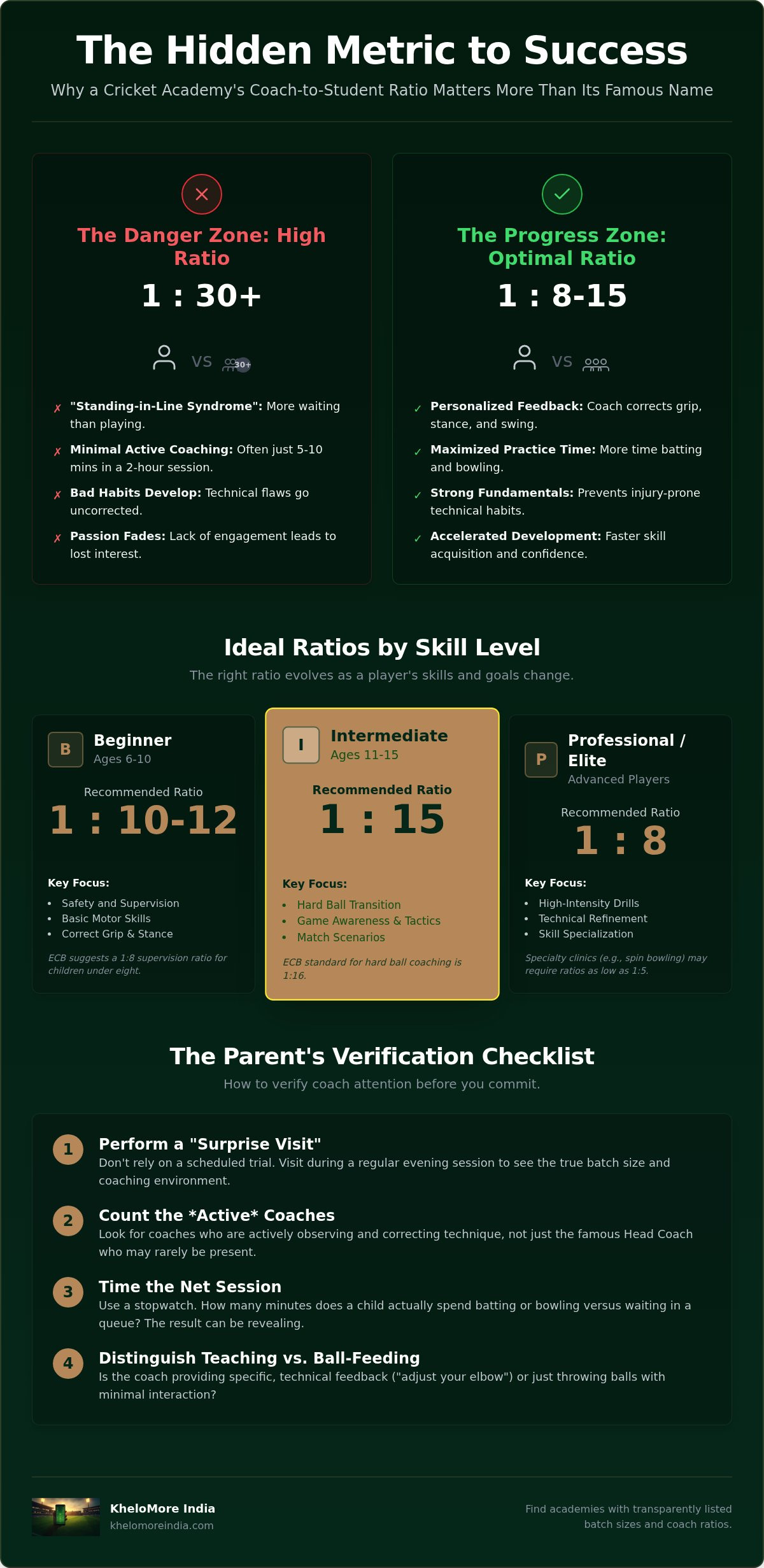
For the Beginner Stage (Ages 6-10), safety is the primary concern alongside basic form. At this age, children lack the focus to train independently. The ECB suggests a supervision ratio of 1:8 for children under eight years old. In a coaching environment, a ratio of 1:10 or 1:12 is necessary. This ensures the coach can watch every swing, correct the grip, and most importantly, keep a group of energetic kids safe around swinging bats and flying balls.
As players move to the Intermediate Level (Ages 11-15), the focus shifts toward game awareness and hard ball cricket. The ECB standard for hard ball coaching is 1:16. A ratio of 1:15 is the sweet spot here. It allows for tactical discussions and group drills while still giving the coach enough time to provide individual feedback to each player. However, for those with professional aspirations in Elite batches, the requirements tighten. Professional refinement requires a cricket academy coach to student ratio of 1:8 or lower, matching the international standard for high-intensity net coaching.
Ratio Benchmarks by Skill Level
To help you compare academies, use these benchmarks as a guide for what to expect based on your child's current stage:
- Beginner (Ages 6-10): 1:10 to 1:12. Focus is on safety, motor skills, and basic stance.
- Intermediate (Ages 11-15): 1:15. Focus is on hard ball transition and match scenarios.
- Professional/Elite: 1:8 or lower. Focus is on high-intensity technical correction and specialization.
Specialty coaching, such as dedicated wicket-keeping or spin bowling clinics, often requires even lower ratios (sometimes 1:5) because the technical nuances are much harder to spot in a large group.
Total Batch Size vs. Coach Ratio
Don't be fooled by small batch sizes alone. A batch of 60 students with 6 qualified coaches is often more effective than a batch of 20 with only 1 coach. Larger academies use "station-based training" to manage these numbers. In this setup, one coach handles slip catching, another manages the batting nets, and a third works on fitness. This keeps the effective ratio low at every "station," ensuring your child is always active. You can use the KheloMore India app to check specific batch details and coach-to-student transparency before you commit to a full term.
How Low Ratios Accelerate Technical Development
A low cricket academy coach to student ratio does more than just keep kids busy. It fundamentally changes the way they learn the game. In a crowded session, a coach is often just a "ball-feeder," making sure everyone gets a turn. But in a focused environment, that coach becomes a technician. They can spot a falling head-position during a drive or a collapsing back leg in a bowling action. These tiny technical flaws, if left uncorrected for months, become permanent muscle memory that is incredibly difficult to fix later.
The "Feedback Loop" is the secret to rapid improvement. Ideally, a player should receive a correction or a word of encouragement after every few deliveries. When a coach is responsible for 20 kids in one net, that feedback loop breaks. A child might bowl three overs with a dangerous, "mixed" action before a coach even notices. By keeping the ratio low, coaches can provide immediate, actionable advice that sticks. This is especially true for fielding drills. In a small group, every child can get fifty or more catches per session, compared to just five or ten in a massive batch.
Correcting the "Common Faults" Early
Unlearning a bad habit is twice as hard as learning a new one. This is why individual attention is so critical during the formative years. Foundational elements like the grip, stance, and backlift require constant monitoring. If a child's grip is too "bottom-handed," they'll struggle to play straight. In low-ratio environments, coaches often use video analysis to show students their own movements. This visual feedback, combined with a coach's expert eye, helps players understand their faults instantly. You can't provide that level of detail when you're managing a crowd.
Safety and Injury Prevention
Safety is often overlooked when discussing coaching metrics, but it shouldn't be. Overcrowded nets are a safety hazard. When too many students are packed into a small space, the risk of being hit by a stray ball or a swinging bat increases significantly. Beyond immediate accidents, a high cricket academy coach to student ratio can lead to long-term physical issues. Without close supervision, young fast bowlers are prone to over-bowling, which is a leading cause of stress fractures in the lower back. A coach who is spread too thin won't notice the signs of fatigue or poor landing mechanics that lead to these injuries. Using a KheloMore India booking guide can help you find academies across India that prioritize these safety standards by maintaining strict batch limits.
The Parent’s Checklist: How to Verify Ratios Before Paying
Choosing an academy based on a brochure is a gamble. To ensure you're getting a fair cricket academy coach to student ratio, you need to see the facility in action when they aren't expecting a new sign-up. Most academies put on their best face during weekend open days or scheduled trials. Instead, try the "Surprise Visit" strategy. Drop by on a Tuesday evening. If the nets are overflowing and coaches look stressed, you've found the real daily environment. It's the most honest way to see if your child will get the attention they deserve.
During your visit, look closely at the staff. Are they actually coaching or just ball-feeding? A ball-feeder simply drops the ball for a batsman without saying a word. A qualified coach stops the session to fix a foot movement or adjust a grip. If you see three coaches but two are just standing around chatting, your effective ratio is much worse than it looks on paper. You want to see active engagement from every adult on the field.
Questions to Ask the Head Coach
- What is the maximum cap for this specific batch? Don't settle for "we keep it small." Ask for the exact number. If they can't give you a limit, they'll likely keep accepting students until the nets are packed.
- Do you use assistant coaches for drills or net supervision? Qualified assistants are great for keeping drills moving, but they should be teaching, not just watching from the sidelines.
- How do you track individual progress in a group setting? Effective academies use logbooks or digital notes to record technical milestones for every player.
Observing the Net Session
A trial class is your best audit tool. While your child is on the field, keep a quiet tally of their "active minutes." This is time spent actually batting, bowling, or receiving direct instructions. If they spend 50 minutes of a 60-minute session standing in the sun, the cricket academy coach to student ratio is failing them. Watch the nets specifically; more than 6-8 kids per net is a major red flag. It means the rotation is too slow, and the coach can't possibly watch every ball. Look for specialized stations where batting, bowling, and fielding happen simultaneously. This shows the academy knows how to distribute their staff effectively. Before you commit your hard-earned money, use KheloMore India to research academies that have been vetted for their coaching standards and batch transparency.
Finding the Right Balance with KheloMore India
Navigating dozens of academies in a city like Mumbai or Bangalore is exhausting. You can't visit every ground at 5:00 PM on a Tuesday just to count heads. This is where KheloMore India steps in as your digital scout. The platform brings much-needed transparency to the cricket academy coach to student ratio by aggregating data from hundreds of facilities across the country. Instead of relying on word-of-mouth, you can see specific batch timings and the level of coach attention provided before you ever leave your house.
One of the best ways to verify an academy's claims is through a trial session. KheloMore India allows you to book test classes at many locations, with some sessions priced as low as ₹99 at specific centers like Wings Sports Center in Bandra. This gives you a low-risk opportunity to perform the "Parent’s Checklist" audit we discussed earlier. You can count the kids in the net and see if the coach is actually providing feedback or just feeding balls. Managing your bookings and receipts through the platform also ensures your investment is protected with clear, transparent payment terms.
Comparing Academies Nationally
The app's interface allows you to filter by location, timing, and specific coaching levels. You can read peer reviews from other parents who have already seen the academy in action. These reviews often highlight if a batch has become too crowded or if the coaches are particularly attentive. It's helpful to remember that KheloMore India simplifies the comparison of fee structures vs. coaching ratios, letting you see exactly what you're paying for. This level of detail helps you avoid the "famous academy" trap where you pay premium prices for very little individual time.
Making an Informed Decision
At the end of the day, a slightly higher monthly fee is a better long-term investment if it means a lower ratio. Paying for a batch of 30 kids is often a waste of money compared to a slightly more expensive batch of 12. In the smaller group, your child gets the technical correction they need to avoid injuries and build a solid foundation. Don't wait until the next enrollment season starts to begin your research. Start comparing your options now to ensure your child isn't just standing in line, but actually playing the game. Download the KheloMore India app to find the best cricket academies in India today.
Choose Progress Over Prestige
Choosing an academy based on fame alone often leads to the frustration of "standing-in-line syndrome." By prioritizing the cricket academy coach to student ratio, you're choosing a path where your child receives the technical corrections necessary for long-term success. It isn't just about the number of hours spent on the ground; it's about the quality of those minutes and the consistency of the feedback loop. When a coach can watch every delivery, the risk of injury drops and the rate of technical improvement skyrockets.
Empower your decision-making by using tools that offer transparency into batch sizes and verified parent feedback. Accessing detailed timing information and secure booking management allows you to protect your investment in your child's sporting future. Find and compare cricket academies with the best coach ratios on the KheloMore India App. With the right guidance and a focused training environment, your child can move beyond the basics and truly master the game.
Frequently Asked Questions
What is a good coach to student ratio for a beginner cricket academy?
A good cricket academy coach to student ratio for beginners is typically 1:10 or 1:12. This level of supervision is necessary because young children require constant guidance to maintain safety and learn basic motor skills. At this stage, a coach needs to watch every swing to prevent bad habits from forming. Anything higher than 1:15 for kids under ten often results in a loss of focus and minimal technical progress.
Does a famous head coach mean the academy has a good coaching ratio?
A famous head coach is often a brand ambassador rather than a daily presence on the field. While their curriculum might be excellent, your child's daily experience depends on the assistant coaches. You should prioritize the number of qualified coaches present during every session over the name on the academy's gate. Always ask who will be conducting the actual drills and what their specific qualifications are.
Why do some academies have 30 kids in one batch?
Many academies maintain batches of 30 or more to keep operational costs low and maximize revenue. This mass-market model allows them to offer lower fees, but it significantly dilutes the quality of instruction. In these environments, coaches often become crowd managers rather than teachers. While these batches might be okay for general fitness, they're rarely effective for developing professional-level cricketing technique.
How does batch size affect my child’s batting time in the nets?
Batch size directly dictates how many deliveries your child faces during a session. In a two-hour practice with 30 kids and only two nets, a child might get only 10 minutes of active batting. The rest of the time is spent retrieving balls or standing in a queue. Smaller batches ensure a faster rotation, meaning more balls faced and more opportunities for the coach to provide immediate technical feedback.
Can a high coach-to-student ratio lead to injuries?
Yes, a poor cricket academy coach to student ratio is a significant risk factor for injuries. Without close supervision, young fast bowlers often bowl too many overs with incorrect mechanics, leading to stress fractures. Overcrowded nets also increase the chance of being hit by stray balls or bats. A coach who is spread too thin can't monitor the fatigue levels or landing positions that are critical for long-term physical safety.
Is individual coaching better than a group academy with a low ratio?
Individual coaching is excellent for fixing specific technical flaws, but group academies with low ratios offer social development and match-scenario training. For most young players, a group setting with a 1:10 ratio provides the best balance. It allows for healthy competition and game-awareness drills that you can't replicate in a one-on-one session. It's often more sustainable and engaging for a child's long-term interest in the sport.
How can I check the real ratio of an academy before joining?
The most effective way to verify the ratio is to visit the academy unannounced on a weekday evening. This shows you the real daily environment rather than a curated trial session. You can also use the KheloMore app to read verified reviews from other parents and check batch transparency details. Counting the number of kids in a single net during your visit will give you an immediate answer.
Do coaching fees in India correlate with the coach-to-student ratio?
Generally, higher coaching fees in India do correlate with better ratios, as hiring more qualified coaches increases the academy's overhead. However, don't assume a high price tag automatically guarantees small batches. Some celebrity academies charge a premium for the brand name while still maintaining large groups. Always verify the specific batch caps and coach counts before committing to a long-term fee structure.
Common questions
What is a good coach to student ratio for a beginner cricket academy?
A good cricket academy coach to student ratio for beginners is typically 1:10 or 1:12. This level of supervision is necessary because young children require constant guidance to maintain safety and learn basic motor skills. At this stage, a coach needs to watch every swing to prevent bad habits from forming. Anything higher than 1:15 for kids under ten often results in a loss of focus and minimal technical progress.
Does a famous head coach mean the academy has a good coaching ratio?
A famous head coach is often a brand ambassador rather than a daily presence on the field. While their curriculum might be excellent, your child's daily experience depends on the assistant coaches. You should prioritize the number of qualified coaches present during every session over the name on the academy's gate. Always ask who will be conducting the actual drills and what their specific qualifications are.
Why do some academies have 30 kids in one batch?
Many academies maintain batches of 30 or more to keep operational costs low and maximize revenue. This mass-market model allows them to offer lower fees, but it significantly dilutes the quality of instruction. In these environments, coaches often become crowd managers rather than teachers. While these batches might be okay for general fitness, they're rarely effective for developing professional-level cricketing technique.
How does batch size affect my child’s batting time in the nets?
Batch size directly dictates how many deliveries your child faces during a session. In a two-hour practice with 30 kids and only two nets, a child might get only 10 minutes of active batting. The rest of the time is spent retrieving balls or standing in a queue. Smaller batches ensure a faster rotation, meaning more balls faced and more opportunities for the coach to provide immediate technical feedback.
Can a high coach-to-student ratio lead to injuries?
Yes, a poor cricket academy coach to student ratio is a significant risk factor for injuries. Without close supervision, young fast bowlers often bowl too many overs with incorrect mechanics, leading to stress fractures. Overcrowded nets also increase the chance of being hit by stray balls or bats. A coach who is spread too thin can't monitor the fatigue levels or landing positions that are critical for long-term physical safety.
Is individual coaching better than a group academy with a low ratio?
Individual coaching is excellent for fixing specific technical flaws, but group academies with low ratios offer social development and match-scenario training. For most young players, a group setting with a 1:10 ratio provides the best balance. It allows for healthy competition and game-awareness drills that you can't replicate in a one-on-one session. It's often more sustainable and engaging for a child's long-term interest in the sport.
How can I check the real ratio of an academy before joining?
The most effective way to verify the ratio is to visit the academy unannounced on a weekday evening. This shows you the real daily environment rather than a curated trial session. You can also use the KheloMore app to read verified reviews from other parents and check batch transparency details. Counting the number of kids in a single net during your visit will give you an immediate answer.
Do coaching fees in India correlate with the coach-to-student ratio?
Generally, higher coaching fees in India do correlate with better ratios, as hiring more qualified coaches increases the academy's overhead. However, don't assume a high price tag automatically guarantees small batches. Some celebrity academies charge a premium for the brand name while still maintaining large groups. Always verify the specific batch caps and coach counts before committing to a long-term fee structure.