Cricket Coaching: What Parents Should Know Before Enrolling Their Child
Unsure about cricket coaching what parents should know? Our guide covers coach ratios, fees, and safety to help you choose the right academy for your child.

Did you know that the ideal coach-to-student ratio for young cricketers is 1:12, yet many local academies often cram over 30 children into a single net session? It's a common worry for parents who want their child to receive individual attention rather than getting lost in a massive crowd. You want to support your child's passion, but the lack of transparency around fees and coaching quality can make the process feel like a guessing game.
Understanding cricket coaching what parents should know is the first step toward turning that backyard hobby into a structured skill. We believe every young athlete deserves a safe, professional environment that matches their specific needs. This guide simplifies your search by providing clear criteria for comparing academies and managing expectations.
You'll discover the right age to start formal training and learn how to evaluate coaching certifications. We also provide a realistic look at current fee structures in India and the essential safety standards required for 2026. This roadmap helps you ensure your child's cricket journey starts on the right foot without the stress of hidden costs or poor supervision.
Key Takeaways
- Learn why the ages of 7 to 9 are the ideal window for starting formal training to build skills without the risk of early physical strain.
- Understand why a low coach-to-student ratio is more important than a famous academy name when evaluating the quality of your child's training.
- Discover the essential facts about cricket coaching what parents should know, including the difference between group match practice and targeted individual sessions.
- Get a clear breakdown of potential hidden costs like registration fees and kit expenses to help you plan your budget effectively.
- Find out how to use digital platforms to compare academies by timing and verified parent reviews before you ever visit the ground.
What is the Best Age to Start Cricket Coaching for Kids?
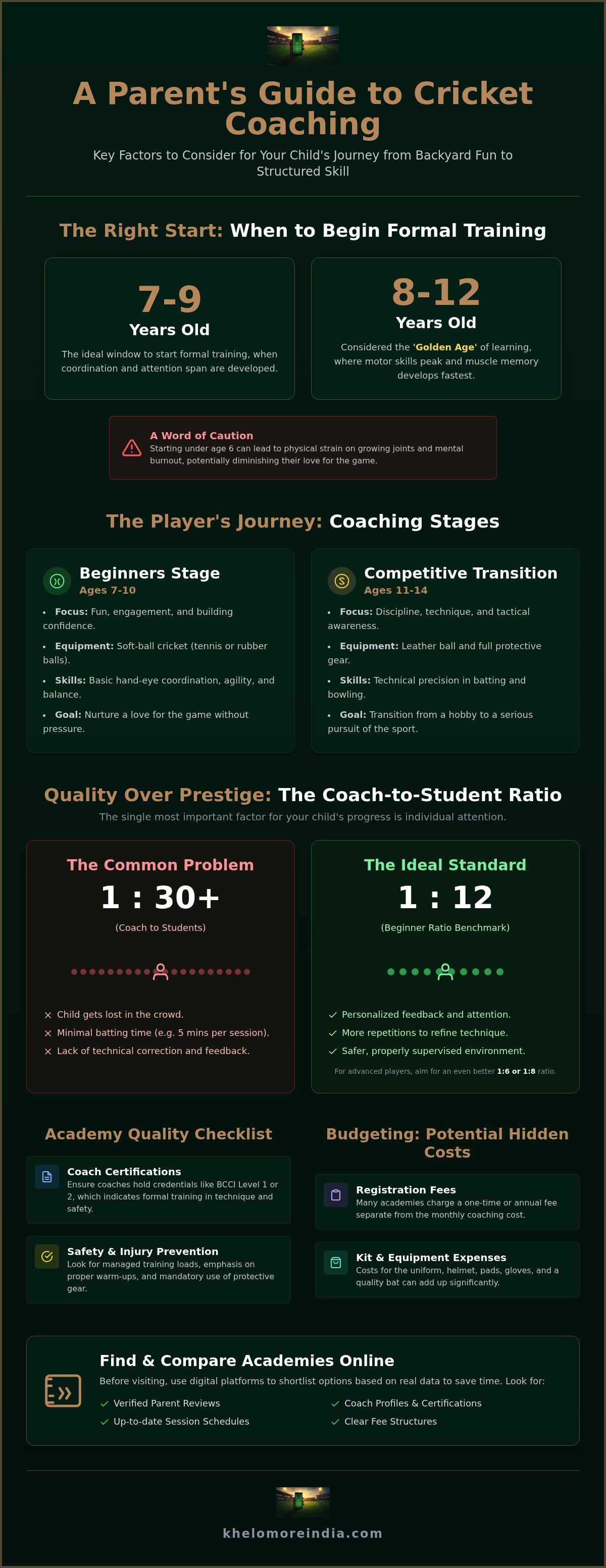
Deciding when to move your child from backyard fun to a professional academy is a big step. Most Indian coaches agree that the best window to start formal training is between ages 7 and 9. At this stage, children have developed the physical coordination and the attention span required to follow instructions on the field. While your five-year-old might show great enthusiasm, their bodies are often not ready for the repetitive movements of structured drills.
Starting too early, specifically under the age of 6, often leads to more harm than good. Young joints and bones are still growing rapidly; excessive bowling or batting practice can cause unnecessary physical strain. There's also a significant risk of mental burnout. If a child feels forced into a rigid routine before they're ready, they might lose their love for the game entirely. It's better to let them enjoy recreational play where they can learn the basic rules of cricket through informal games with friends.
The period between 8 and 12 years is widely considered the 'Golden Age' of learning because this is when a child's motor skill development is at its absolute peak. During these years, they can absorb technical cues and develop "muscle memory" much faster than at any other time in their lives. This is why cricket coaching what parents should know often focuses on capturing this specific window to build a strong foundation.
Coaching for Beginners (Ages 7-10)
In this initial phase, the focus stays on developing hand-eye coordination and basic athletic movements like agility and balance. Coaches typically use soft-ball cricket, using tennis or rubber balls, to help children build confidence. This removes the fear of getting hit by a hard ball, allowing them to focus on their swing and footwork. The goal here isn't to create a finished professional but to ensure the child stays engaged and has fun while learning the basics.
Competitive Transition (Ages 11-14)
Once a child reaches age 11, the training shifts toward a more serious, competitive environment. This is when they transition to the leather ball and begin wearing full protective gear, including helmets, pads, and gloves. Cricket coaching what parents should know at this level involves a deeper focus on technical precision in batting and bowling. Coaches introduce tactical understanding, teaching players how to read a match and react to different game scenarios. It’s the stage where a hobby starts turning into a disciplined pursuit of the sport.
Evaluating Quality: Batch Sizes and Coach-to-Student Ratios
Enrolling your child in a prestigious academy with a former international player's name on the gate sounds like a winning move. However, if that academy has 50 children assigned to a single coach, your investment is likely going to waste. The primary reason young cricketers stop showing progress isn't a lack of talent; it's a lack of individual attention during net sessions. Regarding cricket coaching what parents should know, the math is simple: the larger the batch, the fewer balls your child gets to face.
A massive batch size means your child might spend ninety minutes fielding or waiting in line for just five minutes of batting. This lack of volume prevents them from refining their technique through repetition. High-volume, low-quality sessions also increase the risk of physical fatigue. It's vital to prioritize academies that emphasize preventing youth sports injuries by managing training loads and ensuring every movement is supervised. Beyond numbers, look for coaches with BCCI Level 1 or Level 2 certifications. These credentials ensure the instructor understands age-appropriate drills, safety protocols, and biomechanics.
The Ideal Ratio Benchmark
For beginners, a ratio of one coach to every 10 or 12 children is considered excellent. This allows the coach to watch every player's basic stance and grip while maintaining a fun atmosphere. As a player moves into advanced or competitive levels, the requirements become much stricter. You should look for a 1:6 or 1:8 ratio at this stage because technical corrections in bowling actions or batting footwork require constant, minute-by-minute observation. Before you sign any papers, ask the academy manager exactly how many coaches are present per net session during peak hours. If the answer is vague, it's a red flag for the quality of instruction your child will receive.
Assessing Coach Engagement
Active coaching makes the difference between a child who plays for fun and one who develops a professional edge. Watch a session before enrolling. Is the coach standing silently behind the nets, or are they providing immediate, actionable feedback after every ball? Passive coaching, where an instructor simply watches without correcting errors, leads to ingrained bad habits that are hard to fix later. Modern academies often use video analysis or specialized training aids to show children their progress in real-time. This 'active' style of engagement ensures your child is learning with purpose. To find a facility that prioritizes these standards, you can consult the KheloMore app notes to compare coach-to-student ratios across different local academies.
Cricket Academy vs. Individual Coaching: Which is Right?
Choosing between a group academy and a private coach is a common dilemma for families. It isn't necessarily a choice of one over the other; rather, it's about understanding which format serves your child's current development stage. One of the most critical aspects of cricket coaching what parents should know is how to choose the right environment for their child's specific goals. While academies provide the social foundation of the game, individual sessions offer the surgical precision needed to fix technical flaws.
Most young players begin their journey in a group setting to grasp the basics and enjoy the game's social aspects. However, as they progress, the need for specialized attention often arises. Balancing these two formats is essential to ensure steady improvement without causing physical or mental exhaustion. For a detailed look at top-rated facilities, you can browse our Best Sports Academies for Kids in India: 2026 Guide to see which environments offer the best of both worlds.
Benefits of the Academy Environment
Academies are the heartbeat of the sport because they simulate real-world match conditions. In a group setting, children learn vital life skills like teamwork, communication, and how to handle the pressure of a competitive environment. It's often the most affordable long-term option for daily practice, providing consistent access to nets and teammates. Key benefits include:
- Social Growth: Building friendships and learning to navigate team dynamics.
- Match Exposure: Regular internal matches and opportunities to register for local tournaments.
- Varied Practice: Facing different types of bowlers and practicing various fielding positions in a dynamic setting.
When to Consider Private Coaching
Private coaching is a targeted investment. It's most effective when a player needs to correct a specific technical error, such as a falling head position in a batting stance or an inconsistent release point in a bowling action. These 1-on-1 sessions allow the coach to focus entirely on your child's biomechanics without the distractions of a large group. Consider private sessions if:
- Trial Preparation: Your child is preparing for high-stakes school, district, or state-level trials.
- Rapid Acceleration: You want to fast-track their progress through intensive, personalized drills.
- Mental Toughness: The player needs help building confidence or overcoming a specific performance plateau.
When exploring cricket coaching what parents should know, remember that overtraining is a real risk. A healthy balance might involve three days of academy practice for match awareness and one day of private coaching for technical refinement. This approach keeps the game fun while ensuring the child continues to develop the elite skills required for higher levels of play.
Understanding Fees, Schedules, and Hidden Costs
Fees for cricket academies in India vary significantly based on your location and the facilities provided. In Tier-2 and Tier-3 cities, you can expect to pay between ₹2,500 and ₹8,000 per month. However, in metro cities, monthly tuition can range from ₹6,500 to as high as ₹40,000 for elite programs. A crucial part of cricket coaching what parents should know is the distinction between registration fees and monthly tuition. Many academies charge a one-time joining fee that might not be mentioned in the initial brochure, so always ask for a full breakdown before committing.
Choosing the right schedule is about more than just convenience; it's about consistency. Weekend-only programs are excellent for beginners or children with heavy school workloads. If you're exploring these options, our Weekend Sports Classes for Kids in India: Your Comprehensive Guide provides a deeper look into managing part-time training. Full-week programs offer more intensity but require a disciplined routine to prevent the child from feeling overwhelmed by their schedule.
The True Cost of a Cricket Kit
Budgeting for the sport goes beyond the academy fees. A beginner's cricket kit in India typically costs between ₹8,000 and ₹14,000. This includes essentials like a bat, pads, gloves, a helmet, and an abdominal guard. It's a mistake to buy the most expensive professional-grade gear for a growing child. They'll likely outgrow their pads and shoes within a year. Focus your investment on a high-quality helmet for safety, and stick to mid-range equipment for the rest. Also, remember that most academies require specific white uniforms, which adds another layer to your initial expenses.
Logistics and Timing Challenges
Logistics can make or break a child's interest in the sport. If the academy is located across a high-traffic zone, the long commute will eventually lead to fatigue. Most practice sessions are scheduled for 6:00 AM or 4:00 PM to avoid the harsh afternoon sun. Balancing school homework with these early or late slots takes careful planning. If evening sessions are your only choice, verify that the academy has functional floodlit nets. This ensures your child can practice safely without straining their eyes in poor lighting. To make this process easier, you can compare academy timings and fee transparency online to find a center that fits your family's lifestyle.
How to Find and Compare Cricket Academies Online
Finding the right academy shouldn't feel like a second job. Digital platforms now allow you to skip the manual phone calls and ground visits by filtering for what matters most to your family. You can sort local options by "Coach Attention" and "Timing" to ensure your child isn't just a face in a crowd of fifty during a session that clashes with school. This is a vital part of cricket coaching what parents should know before making a financial commitment. By looking at verified parent reviews, you get an honest look at the academy's daily operations rather than just seeing their marketing highlights. These reviews often reveal details about the actual student-to-coach ratio during peak hours, which can differ from what's advertised on a brochure.
Managing your child's sports journey is much easier when everything is in one place. Digital receipts and booking histories help you track attendance and payments without digging through old emails or paper slips. You can also save your preferences for specific timings, locations, or coach levels. This makes it simple to find similar sports classes for siblings or transition to a different academy if your family moves to a new neighborhood. Using tools like the KheloMore app notes can help you keep these preferences organized and accessible whenever you need to make a quick comparison between two facilities.
What to Look for During a Trial Class
A trial class is your best chance to see the academy's culture in action before you pay for a full term. Don't just watch your child; watch the environment. Check if the equipment is well-maintained. Frayed nets or slipping mats are common safety hazards that shouldn't be ignored. Observe how the coach interacts with the child who is struggling the most in the group. A great coach encourages the least skilled player just as much as the star athlete. You should also check for basic on-site facilities, including:
- Hydration: Is there clean, accessible drinking water for all students?
- Hygiene: Are the washroom facilities clean and close to the practice area?
- Safety: Is there a first-aid kit readily available on the sidelines?
Simplifying the Booking Process
Transparency is key when you're ready to enroll. Use online tools to compare payment terms and refund policies across multiple academies. Some centers offer flexible monthly plans while others require a quarterly commitment. Understanding these details upfront prevents future headaches if your child's school schedule changes. For a step-by-step walkthrough of how to navigate these digital tools and manage your bookings, check out KheloMore: The Ultimate 2026 Guide to Sports Booking in India. This resource helps you manage the entire process from the first trial class to long-term enrollment with confidence. By using a "compare before you pay" philosophy, you ensure that your child's cricket journey starts in a safe, professional, and supportive environment.
Empower Your Child’s Cricket Journey Today
Finding the right training environment doesn't have to be a guessing game. By focusing on the ideal starting age of 7 to 9 and prioritizing low coach-to-student ratios, you ensure your child gets the attention they deserve. We've explored the essential cricket coaching what parents should know, from uncovering hidden kit costs to evaluating the culture of an academy during a trial class. These steps help you move past famous brand names to find a facility that truly cares about your child's individual skill development and physical safety.
Ready to take the next step? You can find and compare the best cricket academies near you on KheloMore. Our platform provides detailed coach-to-student ratios for every listing, along with verified parent reviews and ratings to help you make an informed choice. You'll also benefit from easy digital booking and receipt management to keep your child’s sports schedule organized and stress-free. Your child's passion for the game is a wonderful gift; let's give them the professional start they need to succeed.
Frequently Asked Questions
What is the average monthly fee for cricket coaching in India?
Monthly fees for cricket coaching in India typically range from ₹2,500 to ₹8,000 in Tier-2 and Tier-3 cities. In metro cities, you can expect to pay between ₹6,500 and ₹40,000 depending on the academy's facilities and the profile of the coaches. Premium academies with international-standard infrastructure often charge annual fees exceeding ₹2,00,000. Always confirm if the monthly tuition includes ground maintenance and tournament registration fees.
How do I know if a cricket coach is genuinely qualified?
A genuinely qualified coach should hold a recognized certification, such as a BCCI Level 1, 2, or 3, or an equivalent from the ICC Academy. These credentials ensure the instructor has been trained in modern coaching methods, biomechanics, and player safety. Beyond certifications, observe if the coach maintains a healthy student-to-coach ratio, ideally around 1:12, to ensure every child gets personalized technical feedback during net sessions.
Should my child start with a tennis ball or a leather ball?
Beginners aged 7 to 10 should almost always start with a tennis or soft rubber ball to build hand-eye coordination without the fear of injury. Using a soft ball allows them to focus on their stance and swing mechanics. The transition to a leather ball typically happens around age 11 or 12, once the child has developed basic skills and is comfortable wearing full protective gear like pads and helmets.
How many days a week should a 10-year-old practice cricket?
A 10-year-old should ideally practice 3 to 4 days a week to balance skill development with adequate rest. Practicing every day at this age can lead to physical fatigue or mental burnout. Consistency is more valuable than raw hours; a few high-quality sessions per week are enough to build the necessary muscle memory while keeping the sport fun and engaging for the child.
What should I do if my child's school doesn't have a cricket team?
If your child's school lacks a team, enrolling them in a private academy is the best way to provide them with competitive exposure. Private academies are often affiliated with local cricket associations and can register their students for district-level tournaments and club matches. This ensures your child has a clear pathway to professional cricket regardless of the sports infrastructure available at their school.
Can girls join the same cricket academies as boys in India?
Yes, most modern cricket academies in India are co-educational and actively encourage girls to train alongside boys. This is an important part of cricket coaching what parents should know as the infrastructure for women's cricket has improved significantly. Some elite centers even offer specialized batches for girls led by female coaches to provide a more tailored and comfortable training environment.
What is the best way to prepare for district-level cricket trials?
Preparation for district-level trials involves a combination of technical drills and match-play scenarios. Focus on perfecting your basics with a private coach and participate in as many local club matches as possible to build match temperament. Selectors look for players who demonstrate high fitness levels, a solid defensive technique, and the mental composure to perform when the pressure is high during match simulations.
Is it necessary to buy a full cricket kit before the first trial class?
It is not necessary to buy a full kit before your child's first trial class. Most academies provide shared bats and balls for newcomers to use during their initial evaluation. Once you decide to enroll, you should start by purchasing personal essentials like a helmet and an abdominal guard for hygiene. A full beginner kit in India usually costs between ₹8,000 and ₹14,000 and can be bought gradually.
Common questions
What is the average monthly fee for cricket coaching in India?
Monthly fees for cricket coaching in India typically range from ₹2,500 to ₹8,000 in Tier-2 and Tier-3 cities. In metro cities, you can expect to pay between ₹6,500 and ₹40,000 depending on the academy's facilities and the profile of the coaches. Premium academies with international-standard infrastructure often charge annual fees exceeding ₹2,00,000. Always confirm if the monthly tuition includes ground maintenance and tournament registration fees.
How do I know if a cricket coach is genuinely qualified?
A genuinely qualified coach should hold a recognized certification, such as a BCCI Level 1, 2, or 3, or an equivalent from the ICC Academy. These credentials ensure the instructor has been trained in modern coaching methods, biomechanics, and player safety. Beyond certifications, observe if the coach maintains a healthy student-to-coach ratio, ideally around 1:12, to ensure every child gets personalized technical feedback during net sessions.
Should my child start with a tennis ball or a leather ball?
Beginners aged 7 to 10 should almost always start with a tennis or soft rubber ball to build hand-eye coordination without the fear of injury. Using a soft ball allows them to focus on their stance and swing mechanics. The transition to a leather ball typically happens around age 11 or 12, once the child has developed basic skills and is comfortable wearing full protective gear like pads and helmets.
How many days a week should a 10-year-old practice cricket?
A 10-year-old should ideally practice 3 to 4 days a week to balance skill development with adequate rest. Practicing every day at this age can lead to physical fatigue or mental burnout. Consistency is more valuable than raw hours; a few high-quality sessions per week are enough to build the necessary muscle memory while keeping the sport fun and engaging for the child.
What should I do if my child's school doesn't have a cricket team?
If your child's school lacks a team, enrolling them in a private academy is the best way to provide them with competitive exposure. Private academies are often affiliated with local cricket associations and can register their students for district-level tournaments and club matches. This ensures your child has a clear pathway to professional cricket regardless of the sports infrastructure available at their school.
Can girls join the same cricket academies as boys in India?
Yes, most modern cricket academies in India are co-educational and actively encourage girls to train alongside boys. This is an important part of cricket coaching what parents should know as the infrastructure for women's cricket has improved significantly. Some elite centers even offer specialized batches for girls led by female coaches to provide a more tailored and comfortable training environment.
What is the best way to prepare for district-level cricket trials?
Preparation for district-level trials involves a combination of technical drills and match-play scenarios. Focus on perfecting your basics with a private coach and participate in as many local club matches as possible to build match temperament. Selectors look for players who demonstrate high fitness levels, a solid defensive technique, and the mental composure to perform when the pressure is high during match simulations.
Is it necessary to buy a full cricket kit before the first trial class?
It is not necessary to buy a full kit before your child's first trial class. Most academies provide shared bats and balls for newcomers to use during their initial evaluation. Once you decide to enroll, you should start by purchasing personal essentials like a helmet and an abdominal guard for hygiene. A full beginner kit in India usually costs between ₹8,000 and ₹14,000 and can be bought gradually.